
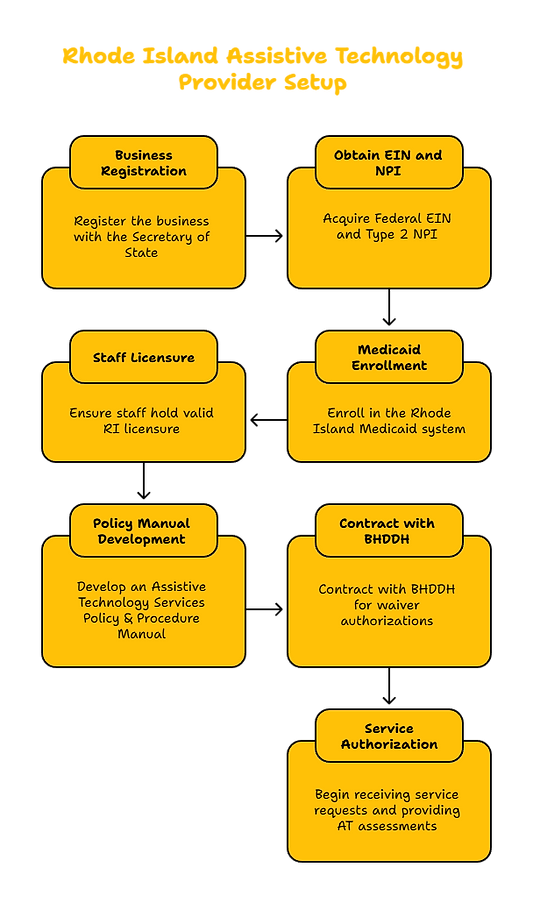
1. Program Definition and Services
Assistive Technology (AT) Services in Rhode Island provide short-term and ongoing support to children and adults with intellectual/developmental disabilities and chronic conditions. The program aims to help maintain individuals with disabilities in the community, averting the need for long-term services and supports by enhancing environmental accessibility, verbal communication, and functional autonomy. Services include:
- In-Home Personal Care: Individual support in the individual/family home or community (AT Functional Needs Assessments, Device Selection & Sourcing of communication or daily living aids, Individualized Device Customization, and Specialized Participant/Caregiver Training)
- Residential Personal Care: Supervision and care in a licensed residential, community-based setting (Home Accessibility Adaptations, Equipment Fit/Modification Oversight, Preventative Device Maintenance, and Specialized Technical Repair Workflows)
2. Regulations
The program is governed by the following regulations:
- Rhode Island Code of Regulations (RICR) Title 212, Chapter 10, Part 5 (Rules and Regulations for Developmental Disability Organizations)
- 210-RICR-20-00-2 (Rhode Island Medicaid Durable Medical Equipment and Assistive Devices Coverage)
- Rhode Island Medicaid 1115 Comprehensive Demonstration Waiver
- Federal HCBS Settings Final Rule (42 CFR 441.301)
3. Licensing or Certification
Providers delivering clinical assessments must utilize personnel licensed by the Rhode Island Department of Health (RIDOH). To supply waiver-funded equipment, entities must be certified as an Assistive Technology / Durable Medical Equipment (DME) Provider by the Executive Office of Health and Human Services (EOHHS) and/or the Department of Behavioral Healthcare, Developmental Disabilities & Hospitals (BHDDH), adhering to all Home and Community-Based Services (HCBS) requirements.
4. Responsible State Agency
The Rhode Island Executive Office of Health and Human Services (EOHHS) and the Department of Behavioral Healthcare, Developmental Disabilities & Hospitals (BHDDH) Division of Developmental Disabilities are responsible for reviewing applications and certifying assistive technology services providers.
5. Application Process
The application process is conducted through the electronic Rhode Island Medicaid Healthcare Portal.
6. Required Documentation
While specific documentation requirements vary based on the target waiver, providers typically need to submit:
- Proof of business compliance with state commercial rules (including BHDDH or RIDOH credentials)
- Agency policies and procedures (detailing clinical intake evaluation, device delivery tracking, safety modifications, and repair workflows)
- Staff professional qualifications and state primary-source clinical licenses (e.g., OTs, PTs, SLPs)
- Proof of general business liability, worker's compensation, and comprehensive product liability insurance
7. Timeline for Approval
The exact timeline for approval fluctuates based on state agency processing capacity. Providers should contact their designated EOHHS or BHDDH provider enrollment coordinator for detailed information on current processing timeframes, which typically range from 2 to 4 months.
8. Pre-Application Process
Prospective providers must complete specific foundation tasks before applying. They must establish their business entity with the Rhode Island Secretary of State, purchase necessary product liability insurance riders, build a warehouse space or secure a medical device supply chain, and obtain necessary federal identification numbers (EIN and an Organizational Type 2 NPI).
9. Pre-Application Training
The state hosts mandatory administrative and compliance training sessions online. Program coordinators and technicians must complete specific orientation modules regarding Medicaid Prior Authorization (PA) guidelines, Letters of Medical Necessity (LMN) formulation workflows, and HIPAA data security rules for digital devices.
10. Additional Notes
Providers must ensure that intensive care or customized device settings meet all state accessibility, manufacturer, and environmental safety guidelines
In-Home Personal Care must be provided directly by the certified agency's employed or contracted specialized clinicians
All direct care and technical installation staff must conduct mandatory background clearances and fingerprinting screenings through the RI Attorney General's Bureau of Criminal Identification (BCI)
Providers must maintain detailed records of face-to-face services for Medicaid documentation and billing, ensuring every device aligns perfectly with the goals outlined in the participant's Individual Support Plan (ISP)
Why Choose Waiver Consulting Group?
Starting or expanding your Medicaid waiver-funded agency can feel overwhelming, but it doesn't have to be. At Waiver Consulting Group, we simplify the process by guiding you through licensing, compliance, provider enrollment, policies & procedures, and regulatory approvals in any state.
With proven expertise, a structured process
To get started, click the link to request portal access