
1. Program Definition and Services
Non-Medical Transportation (NMT) Services in Rhode Island provide essential transit support to adults with intellectual/developmental disabilities (I/DD), physical constraints, and senior citizens. Distinct from medical transit, this program focuses on community integration, vocational pursuits, and social participation. Services include:
- In-Home Personal Care: Curbside and driver-assisted mobility links between a participant's home and authorized community spaces (Door-to-Door Transportation, Fixed Route & Scheduled Day-Program Transit, Errand Sourcing, and Escort Accompaniment)
- Residential Personal Care: Supervised vehicle coordination and transit logistics centered around a facility base or employment location (Accessible Vehicle Transport utilizing wheelchair lift-equipped vans, Vocational Commute Mapping, and real-time electronic Trip Logging)
2. Regulations
The program is governed by the following regulations:
- Rhode Island General Laws Title 39, Chapter 39-13 & 39-14.1 (Motor Carriers of Passengers)
- 212-RICR-10-05-1 (BHDDH Standards for Developmental Disability Organizations)
- Rhode Island Medicaid 1115 Comprehensive Demonstration Waiver
- Federal HCBS Settings Final Rule (42 CFR 441.301)
3. Licensing or Certification
Providers must secure a Common Carrier Certificate or operating authority from the Rhode Island Division of Public Utilities and Carriers (DPUC) Motor Carriers Section. Additionally, providers must be certified as an Home and Community-Based Services (HCBS) transportation provider by EOHHS or BHDDH.
4. Responsible State Agency
The Rhode Island Executive Office of Health and Human Services (EOHHS), the Department of Behavioral Healthcare, Developmental Disabilities & Hospitals (BHDDH), and the Rhode Island Division of Public Utilities and Carriers (DPUC) share joint jurisdiction over provider enrollment, vehicle safety monitoring, and operator compliance.
5. Application Process
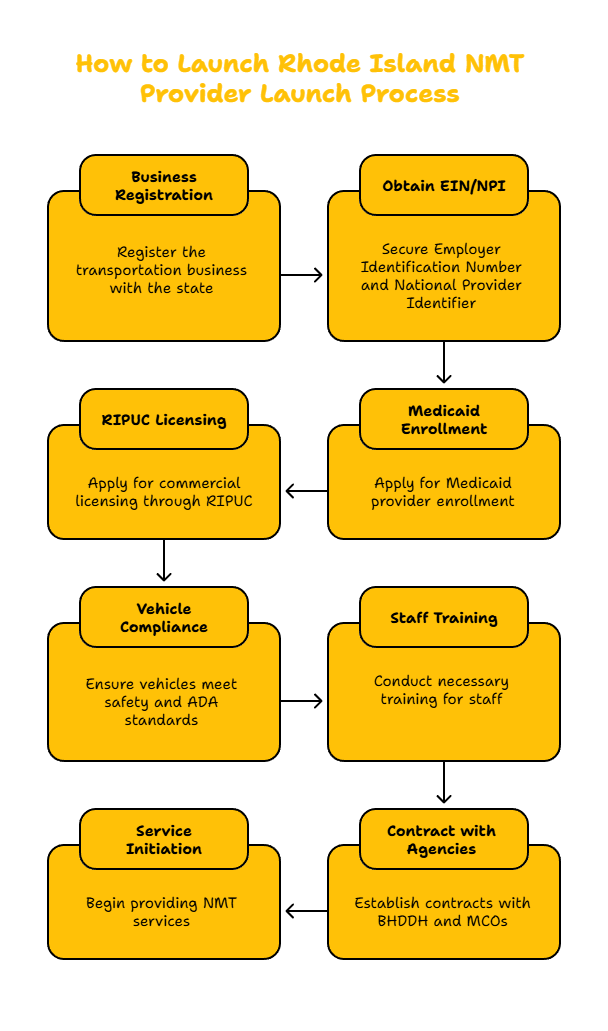
The application process involves a multi-agency sequence. First, agencies file a formal application with the DPUC Motor Carriers Section and pass a public fitness hearing. Once the DPUC issues an operating certificate, the provider registers its vehicles and completes final network authorization through the electronic Rhode Island Medicaid Healthcare Portal.
6. Required Documentation
While specific requirements vary by waiver program, providers must submit:
- State Business Registration and a valid RI DPUC Common Carrier Operating Certificate
- Proof of specialized commercial vehicle insurance (Form E/Form K filings)
- NMT Operations Policy & Procedure Manual (covering ADA securement protocols, incident response, and vehicle maintenance)
- Current Division of Motor Vehicles (DMV) certified driving records for all staff operators
- Validated state Bureau of Criminal Identification (BCI) background clearances for all drivers
7. Timeline for Approval
The multi-agency vetting loop, including the mandatory DPUC public hearing notice period, vehicle visual compliance inspections, and EOHHS system setup, typically spans 3 to 5 months.
8. Pre-Application Process
Before filing with state regulators, prospective providers must register their business with the Rhode Island Secretary of State, purchase or lease ADA-compliant fleet vehicles (such as hydraulic lift vans), establish a localized dispatch center, and acquire their federal EIN and an Organizational Type 2 NPI.
9. Pre-Application Training
The state mandates specialized administrative and fleet orientation modules. Prior to passenger transport, all drivers must complete certified instruction covering ADA Wheelchair Tie-Down and Lift Securement (PASS training), Defensive Driving Tactics, Electronic Trip Log/EVV Verification compliance, and mandated abuse reporting protocols.
10. Additional Notes
- Providers must ensure that fleet logistics and vehicle modifications meet all federal DOT, ADA, and state safety guidelines
- In-Home Personal Care transportation routing must be executed directly by the certified agency's employed, background-checked personnel
- All direct care and driving staff must conduct mandatory background clearances and fingerprinting screenings through the RI Attorney General's Bureau of Criminal Identification (BCI)
- Providers must maintain detailed electronic logs of service delivery for Medicaid documentation and billing, tracking precise timestamps, mileages, and destination intent to ensure full compliance with community integration goals
Why Choose Waiver Consulting Group?
Starting or expanding your Medicaid waiver-funded agency can feel overwhelming, but it doesn't have to be. At Waiver Consulting Group, we simplify the process by guiding you through licensing, compliance, provid
With proven expertise, a structured process, and ongo
To get started, click the link to request portal access