
SUPPORTING CAREGIVERS AND PROMOTING PARTICIPANT WELL-BEING THROUGH TEMPORARY RELIEF SERVICES
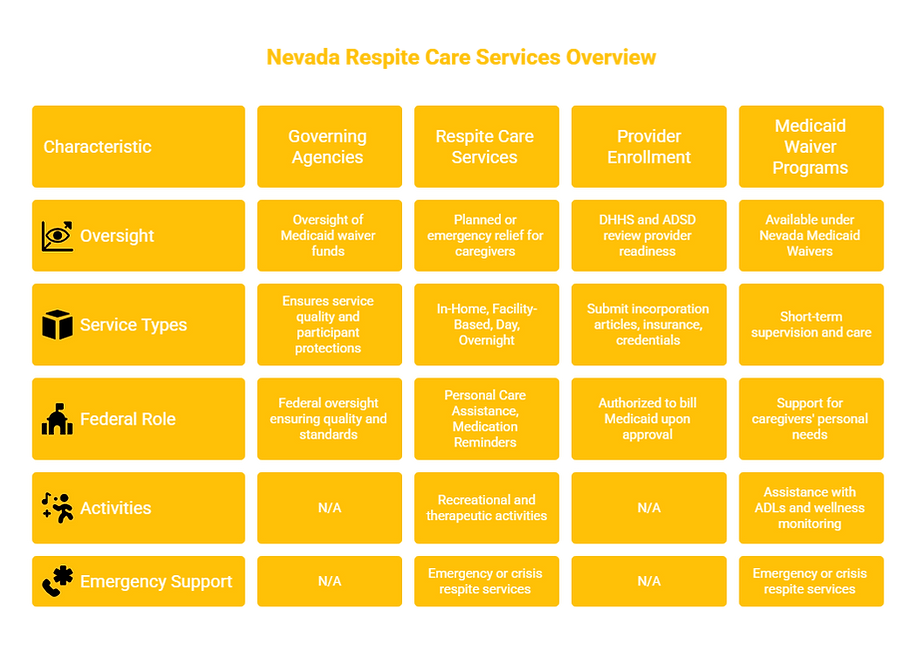
Respite Care Services in Nevada provide temporary relief for family caregivers of individuals with disabilities, chronic illnesses, or age-related conditions. These services ensure the participant’s safety and well-being while allowing primary caregivers to rest, attend to personal matters, or recover from caregiver fatigue. Respite Care Services are authorized under Nevada Medicaid Home and Community-Based Services (HCBS) Waiver programs.
1. GOVERNING AGENCIES
Agency: Nevada Department of Health and Human Services (DHHS)
Role: Administers Medicaid waiver funding for Respite Care Services and manages provider enrollment, service authorization, and reimbursement.
Agency: Aging and Disability Services Division (ADSD)
Role: Ensures service quality, participant protections, and respite service compliance under HCBS waiver programs.
Agency: Centers for Medicare & Medicaid Services (CMS)
Role: Provides federal oversight ensuring Medicaid-funded Respite Care Services meet HCBS quality, person-centered planning, and participant protection standards.
2. RESPITE CARE SERVICES OVERVIEW
Respite Care Services offer planned or emergency relief for unpaid caregivers while ensuring participants receive appropriate supervision, personal care, and support services.
Approved providers may deliver:
- In-Home Respite Services: Care provided in the participant’s residence
- Facility-Based Respite Care: Temporary care provided in licensed community settings
- Day Respite: Supervision and support during daytime hours
- Overnight or Weekend Respite: Extended care to accommodate caregiver breaks
- Personal Care Assistance: Help with Activities of Daily Living (ADLs) such as bathing, grooming, feeding, mobility, and toileting
- Medication Reminders: Basic health monitoring and assistance (non-skilled tasks)
- Recreational Activities: Engaging participants in social or therapeutic activities
All respite care must align with the participant’s Individualized Service Plan (ISP) and reflect the participant’s health and safety needs.
3. LICENSING & PROVIDER APPROVAL REQUIREMENTS
Prerequisites:
- Register the business entity with the Nevada Secretary of State
- Obtain EIN from the IRS and NPI (Type 2)
- Enroll as a Medicaid Waiver Respite Care provider through the Nevada Medicaid Provider Enrollment Portal
- Obtain facility licensure (if providing facility-based respite) from DHHS or ADSD as applicable
- Maintain general liability and professional liability insurance
- Develop comprehensive policies for participant intake, caregiver communication, incident reporting, participant health and safety, and emergency procedures
- Ensure all direct care staff meet background screening, health screenings, and training requirements
4. NEVADA PROVIDER ENROLLMENT PROCESS
Initial Interest and Application:
- Complete the Provider Enrollment Application through the Nevada Medicaid Provider Enrollment Portal for Respite Care Services under appropriate HCBS waivers
Application and Documentation Submission:
- Submit Articles of Incorporation, proof of EIN/NPI, liability insurance certificates, staff credentialing documentation, and service policies
Program Readiness Review:
- DHHS and ADSD review provider readiness, including staff qualifications, care and supervision protocols, participant safety plans, and documentation systems
Approval & Medicaid Enrollment:
- Upon approval, providers are authorized to bill Medicaid for In-Home and/or Facility-Based Respite Services using assigned billing codes
5. REQUIRED DOCUMENTATION
- Articles of Incorporation or Business License (Nevada Secretary of State)
- IRS EIN confirmation
- NPI confirmation
- Facility License (for facility-based respite providers)
- Proof of general and professional liability insurance
Respite Care Services Policy & Procedure Manual including:
- Participant intake, care planning, and service scheduling procedures
- Health and safety monitoring, medication reminders, and supervision protocols
- Emergency preparedness, abuse prevention, and critical incident reporting policies
- Participant rights, HIPAA confidentiality procedures, and grievance handling
- Staff credentialing, background checks, first aid/CPR certification documentation
- Medicaid billing, service tracking, and audit readiness procedures
6. STAFFING REQUIREMENTS
Role: Respite Services Program Director / Supervisor
Requirements: Bachelor’s degree in human services, healthcare, or related field preferred, background clearance, supervisory experience in direct care settings preferred.
Role: Respite Care Workers / Direct Support Professionals
Requirements: High school diploma or GED, CPR/First Aid certification, completion of respite-specific or direct care training, background screening and health clearance.
All staff must complete:
- Participant safety and emergency preparedness training
- HIPAA compliance and participant rights training
- Abuse, neglect, and exploitation prevention training
- Infection control and wellness monitoring training
- Annual competency evaluations and continuing education
7. MEDICAID WAIVER PROGRAMS
Respite Care Services are available under the following Nevada Medicaid Waivers:
- Frail Elderly (FE) Waiver
- Intellectual and Developmental Disabilities (IDD) Waiver
- Physical Disabilities Waiver
- Traumatic Brain Injury (TBI) Waiver
- Home and Community-Based Services (HCBS) Waiver
Services may include:
- Short-term in-home or facility-based supervision and care
- Temporary support allowing unpaid caregivers to attend to personal needs
- Assistance with basic ADLs and wellness monitoring during respite periods
- Emergency or crisis respite services when caregiver availability is compromised
8. TIMELINE TO LAUNCH
Phase: Business Formation and Compliance Preparation
Timeline: 1–2 months
Phase: Staff Hiring, Credentialing, and Program Development
Timeline: 2–3 months
Phase: Nevada Medicaid Provider Enrollment and Readiness Review
Timeline: 60–90 days
Phase: Medicaid Billing Setup and Respite Care Service Launch
Timeline: 30–45 days
9. CONTACT INFORMATION
Nevada Department of Health and Human Services (DHHS)
Website: https://dhhs.nv.gov/
Aging and Disability Services Division (ADSD)
Website: https://adsd.nv.gov/
Nevada Medicaid Provider Enrollment Portal
Website: https://www.medicaid.nv.gov/
Centers for Medicare & Medicaid Services (CMS)
Website: https://www.cms.gov/
10. SCOPE OF WORK
- Business registration, Medicaid enrollment, and facility licensure support
- Development of Respite Care Services Policy & Procedure Manual
- Staff credentialing templates, participant intake forms, and emergency planning templates
- Medicaid billing system setup and audit-ready claims management
- Website, domain, and professional branding development
- Caregiver training program templates and participant satisfaction surveys
- Quality assurance systems for incident reporting, service tracking, and compliance monitoring
WAIVER CONSULTING GROUP’S START-UP ASSISTANCE SERVICE — NEVADA RESPITE CARE SERVICES PROVIDER
We support agencies in launching Medicaid-compliant Respite Care Services in Nevada.
To get started, click the link to request portal access