
These videos give an overview of the various Home and Community-Based Services (HCBS) available in North Carolina for providers who want to learn how to start or operate an HCBS agency in the state. Each video explains the purpose of the service, provider requirements, licensing process, and how the program functions. Use these videos to better understand the responsibilities, standards, and steps involved in becoming or working with approved HCBS providers in North Carolina. Explore each section to find the service that best matches your goals or area of interest.
Respite Care
RESPITE CARE SERVICES PROVIDER IN NORTH CAROLINA
PROVIDING TEMPORARY RELIEF FOR PRIMARY CAREGIVERS THROUGH SAFE AND COMPASSIONATE SUPPORT
Respite Care Services in North Carolina provide short-term, temporary relief for primary caregivers of individuals with disabilities, chronic illnesses, or age-related conditions. These services ensure that the individual continues to receive quality care while allowing caregivers to take a break from their duties. Respite Care Services are authorized under North Carolina Medicaid Home and Community-Based Services (HCBS) Waiver programs.
1. GOVERNING AGENCIES
Agency: North Carolina Department of Health and Human Services (NCDHHS)
Role: Administers Medicaid waiver funding for Respite Care Services and oversees provider enrollment, service authorization, and reimbursement.
Agency: North Carolina Division of Health Benefits (NC Medicaid)
Role: Manages Medicaid waiver services and oversees Medicaid provider participation.
Agency: North Carolina Division of Mental Health, Developmental Disabilities, and Substance Abuse Services (DMH/DD/SAS)
Role: Provides oversight for respite care services targeting individuals with developmental disabilities and behavioral health needs.
Agency: Centers for Medicare & Medicaid Services (CMS)
Role: Provides federal oversight to ensure Medicaid-funded Respite Care Services meet quality, safety, and person-centered care standards.
2. RESPITE CARE SERVICES OVERVIEW
Respite Care Services offer temporary relief to primary caregivers by providing short-term care for individuals with physical, developmental, or mental health needs.
Approved providers may deliver:
In-Home Respite Care: Providing care within the individual’s home environment.
Out-of-Home Respite Care: Temporary care in a licensed facility or community setting.
Emergency Respite: Immediate care during unexpected caregiver absences.
Planned Respite: Scheduled care for routine caregiver breaks or planned absences.
Overnight Respite: Providing care during nighttime hours.
Personal Care Assistance: Helping with bathing, grooming, meal preparation, and mobility.
Social and Recreational Activities: Engaging individuals in safe, enjoyable interactions.
Health Monitoring: Administering medication and tracking vital signs when needed.
Behavioral Support: Managing challenging behaviors with positive intervention techniques.
Documentation: Maintaining accurate records of care provided and individual progress.
3. LICENSING & PROVIDER APPROVAL REQUIREMENTS
Prerequisites:
Register the business entity with the North Carolina Secretary of State.
Obtain EIN from the IRS and NPI (Type 2).
Enroll as a Medicaid Waiver Respite Care provider via the NCTracks Provider Portal.
Maintain general liability and professional liability insurance.
Develop policies for respite care planning, safety management, and caregiver support.
Ensure staff complete required background checks, health screenings, and respite care training.
4. NORTH CAROLINA PROVIDER ENROLLMENT PROCESS
Initial Interest and Application:
Complete the Provider Enrollment Application via the NCTracks Portal for Respite Care Services under HCBS waivers.
Application and Documentation Submission:
Submit Articles of Incorporation, proof of EIN/NPI, insurance certificates, respite care policies, and staff training documentation.
Program Readiness Review:
NCDHHS and DMH/DD/SAS evaluate provider readiness, including care protocols, safety standards, and staff qualifications.
Approval & Medicaid Enrollment:
Upon approval, providers are authorized to bill Medicaid for Respite Care Services using designated billing codes.
5. REQUIRED DOCUMENTATION
Articles of Incorporation or Business License (North Carolina Secretary of State)
IRS EIN confirmation
NPI confirmation
Proof of general and professional liability insurance
Respite Care Policy & Procedure Manual including:
Care planning, emergency respite, and caregiver relief protocols
Personal care and safety management procedures
Staff credentialing, background checks, and ongoing training records
Documentation standards for care tracking and Medicaid billing
HIPAA compliance, participant rights, and grievance handling
Safety, infection control, and hygiene practices
Quality assurance and compliance monitoring
6. STAFFING REQUIREMENTS
Role: Respite Care Program Director
Requirements: Bachelor’s or Master’s degree in social work, human services, or healthcare administration; experience in respite care program management.
Role: Respite Care Workers
Requirements: Certification in direct care or caregiving; experience with individuals with disabilities or chronic conditions; background clearance.
Role: Personal Care Aides (PCAs)
Requirements: Completion of an approved PCA training program; experience in personal care and direct support.
All staff must complete:
Training in respite care techniques, client safety, and caregiver interaction
HIPAA compliance and participant rights education
Annual competency evaluations and ongoing professional development
Safety, emergency response, and infection control training
Documentation and record-keeping best practices
7. MEDICAID WAIVER PROGRAMS
Respite Care Services are available under the following North Carolina Medicaid Waivers:
Innovations Waiver
Community Alternatives Program for Disabled Adults (CAP/DA)
Community Alternatives Program for Children (CAP/C)
Traumatic Brain Injury (TBI) Waiver
Home and Community-Based Services (HCBS) Waiver
8. TIMELINE TO LAUNCH
Phase: Business Formation and Compliance Preparation
Timeline: 1–2 months
Phase: Staff Hiring, Credentialing, and Program Development
Timeline: 2–3 months
Phase: North Carolina Medicaid Provider Enrollment and Readiness Review
Timeline: 60–90 days
Phase: Medicaid Billing Setup and Respite Care Service Launch
Timeline: 30–45 days
9. CONTACT INFORMATION
North Carolina Department of Health and Human Services (NCDHHS)
Website: https://www.ncdhhs.gov/
NCTracks Provider Enrollment Portal
Website: https://www.nctracks.nc.gov/
North Carolina Division of Health Benefits (NC Medicaid)
Website: https://medicaid.ncdhhs.gov/
North Carolina Division of Mental Health, Developmental Disabilities, and Substance Abuse Services (DMH/DD/SAS)
Website: https://www.ncdhhs.gov/divisions/mhddsas
Centers for Medicare & Medicaid Services (CMS)
Website: https://www.cms.gov/
WAIVER CONSULTING GROUP’S START-UP ASSISTANCE SERVICE — NORTH CAROLINA RESPITE CARE SERVICES PROVIDER
WCG supports agencies in launching Medicaid-compliant Respite Care Services in North Carolina, offering:
Scope of Work:
Business registration, Medicaid enrollment, and licensing assistance
Policy manual development for respite care and caregiver support
Staff credentialing, training program templates, and compliance documentation
Medicaid billing setup and audit-prepared financial management
Branding, website development, and client outreach strategies
Quality assurance systems for care coordination and compliance monitoring
Collaboration with healthcare providers, family caregivers, and community organizations

Residential Habilitation
RESIDENTIAL SUPPORT SERVICES PROVIDER IN NORTH CAROLINA
PROVIDING SAFE, SUPPORTIVE LIVING ENVIRONMENTS FOR INDIVIDUALS WITH DISABILITIES AND CHRONIC CONDITIONS
Residential Support Services in North Carolina help individuals with disabilities, mental health challenges, or chronic conditions live independently or semi-independently within community settings. These services include assistance with daily living, health monitoring, and community integration, fostering independence and quality of life. Residential Support Services are authorized under North Carolina Medicaid Home and Community-Based Services (HCBS) Waiver programs.
1. GOVERNING AGENCIES
Agency: North Carolina Department of Health and Human Services (NCDHHS)
Role: Administers Medicaid waiver funding for Residential Support Services and oversees provider enrollment, service authorization, and reimbursement.
Agency: North Carolina Division of Health Benefits (NC Medicaid)
Role: Manages Medicaid waiver services and oversees Medicaid provider participation.
Agency: North Carolina Division of Mental Health, Developmental Disabilities, and Substance Abuse Services (DMH/DD/SAS)
Role: Provides oversight for residential services targeting individuals with developmental disabilities and behavioral health needs.
Agency: Centers for Medicare & Medicaid Services (CMS)
Role: Provides federal oversight to ensure Medicaid-funded Residential Support Services meet quality, safety, and person-centered care standards.
2. RESIDENTIAL SUPPORT SERVICES OVERVIEW
Residential Support Services are designed to provide individuals with disabilities the necessary support to live independently within residential settings, including group homes, supported apartments, or individual residences.
Approved providers may deliver:
Personal Care Assistance: Assisting with bathing, dressing, grooming, and mobility.
Daily Living Skills Training: Teaching cooking, cleaning, budgeting, and personal care.
Health Monitoring: Managing medications and overseeing chronic conditions.
Behavioral Support: Addressing behavioral challenges and promoting positive interactions.
Social Integration: Encouraging community participation and relationship-building.
Crisis Intervention: Managing behavioral or health-related emergencies.
Household Management: Supporting meal planning, housekeeping, and maintenance.
Transportation Support: Facilitating access to medical appointments and community activities.
Safety Monitoring: Ensuring a safe and supportive living environment.
Documentation: Maintaining records of services provided, individual progress, and care plans.
3. LICENSING & PROVIDER APPROVAL REQUIREMENTS
Prerequisites:
Register the business entity with the North Carolina Secretary of State.
Obtain EIN from the IRS and NPI (Type 2).
Enroll as a Medicaid Waiver Residential Support provider via the NCTracks Provider Portal.
Maintain general liability and professional liability insurance.
Develop policies for residential care, personal support, and safety management.
Ensure staff complete required background checks, health screenings, and training in residential support practices.
4. NORTH CAROLINA PROVIDER ENROLLMENT PROCESS
Initial Interest and Application:
Complete the Provider Enrollment Application via the NCTracks Portal for Residential Support Services under HCBS waivers.
Application and Documentation Submission:
Submit Articles of Incorporation, proof of EIN/NPI, insurance certificates, residential care policies, and staff training documentation.
Program Readiness Review:
NCDHHS and DMH/DD/SAS evaluate provider readiness, including care protocols, safety measures, and staff qualifications.
Approval & Medicaid Enrollment:
Upon approval, providers are authorized to bill Medicaid for Residential Support Services using designated billing codes.
5. REQUIRED DOCUMENTATION
Articles of Incorporation or Business License (North Carolina Secretary of State)
IRS EIN confirmation
NPI confirmation
Proof of general and professional liability insurance
Residential Support Policy & Procedure Manual including:
Personal care and daily living assistance protocols
Safety, crisis intervention, and emergency response procedures
Staff credentialing, background checks, and ongoing training records
Documentation standards for care tracking and Medicaid billing
HIPAA compliance, participant rights, and grievance handling
Quality assurance and compliance monitoring
Infection control and hygiene practices
6. STAFFING REQUIREMENTS
Role: Residential Program Director
Requirements: Bachelor’s or Master’s degree in social work, healthcare administration, or human services; experience in residential care management.
Role: Direct Support Professionals (DSPs)
Requirements: High school diploma or GED; experience in personal care and residential support; background clearance.
Role: Residential Coordinators
Requirements: Experience in community integration, independent living support, and case management.
All staff must complete:
Training in personal care, community integration, and client safety
HIPAA compliance and participant rights education
Annual competency evaluations and ongoing professional development
Safety, emergency response, and behavior management training
Documentation and record-keeping best practices
7. MEDICAID WAIVER PROGRAMS
Residential Support Services are available under the following North Carolina Medicaid Waivers:
Innovations Waiver
Community Alternatives Program for Disabled Adults (CAP/DA)
Community Alternatives Program for Children (CAP/C)
Traumatic Brain Injury (TBI) Waiver
Home and Community-Based Services (HCBS) Waiver
8. TIMELINE TO LAUNCH
Phase: Business Formation and Compliance Preparation
Timeline: 1–2 months
Phase: Staff Hiring, Credentialing, and Program Development
Timeline: 2–3 months
Phase: North Carolina Medicaid Provider Enrollment and Readiness Review
Timeline: 60–90 days
Phase: Medicaid Billing Setup and Residential Support Service Launch
Timeline: 30–45 days
9. CONTACT INFORMATION
North Carolina Department of Health and Human Services (NCDHHS)
Website: https://www.ncdhhs.gov/
NCTracks Provider Enrollment Portal
Website: https://www.nctracks.nc.gov/
North Carolina Division of Health Benefits (NC Medicaid)
Website: https://medicaid.ncdhhs.gov/
North Carolina Division of Mental Health, Developmental Disabilities, and Substance Abuse Services (DMH/DD/SAS)
Website: https://www.ncdhhs.gov/divisions/mhddsas
Centers for Medicare & Medicaid Services (CMS)
Website: https://www.cms.gov/
WAIVER CONSULTING GROUP’S START-UP ASSISTANCE SERVICE — NORTH CAROLINA RESIDENTIAL SUPPORT SERVICES PROVIDER
WCG supports agencies in launching Medicaid-compliant Residential Support Services in North Carolina, offering:
Scope of Work:
Business registration, Medicaid enrollment, and licensing assistance
Policy manual development for residential care and personal support
Staff credentialing, training program templates, and compliance documentation
Medicaid billing setup and audit-prepared financial management
Branding, website development, and client outreach strategies
Quality assurance systems for residential support and compliance monitoring
Collaboration with housing agencies, healthcare providers, and community organizations

Supported Employment
SUPPORTED EMPLOYMENT SERVICES PROVIDER IN NORTH CAROLINA
EMPOWERING INDIVIDUALS WITH DISABILITIES TO ACHIEVE AND MAINTAIN EMPLOYMENT THROUGH PERSONALIZED SUPPORT
Supported Employment Services in North Carolina assist individuals with disabilities or mental health challenges in obtaining and retaining competitive employment. These services offer individualized support, job training, and on-the-job assistance to foster long-term employment success. Supported Employment Services are authorized under North Carolina Medicaid Home and Community-Based Services (HCBS) Waiver programs.
1. GOVERNING AGENCIES
Agency: North Carolina Department of Health and Human Services (NCDHHS)
Role: Administers Medicaid waiver funding for Supported Employment Services and oversees provider enrollment, service authorization, and reimbursement.
Agency: North Carolina Division of Health Benefits (NC Medicaid)
Role: Manages Medicaid waiver services and oversees Medicaid provider participation.
Agency: North Carolina Division of Vocational Rehabilitation Services (NCDVRS)
Role: Provides oversight for supported employment services targeting individuals with disabilities.
Agency: Centers for Medicare & Medicaid Services (CMS)
Role: Provides federal oversight to ensure Medicaid-funded Supported Employment Services meet quality, safety, and person-centered care standards.
2. SUPPORTED EMPLOYMENT SERVICES OVERVIEW
Supported Employment Services are designed to help individuals with disabilities gain meaningful employment through tailored job support, training, and on-the-job assistance.
Approved providers may deliver:
Job Development: Identifying job opportunities that match the individual’s skills and interests.
Employment Assessment: Evaluating strengths, job readiness, and vocational preferences.
Job Placement: Assisting with job applications, interviews, and hiring processes.
Job Coaching: Providing one-on-one training and support during the initial employment phase.
Skills Training: Teaching soft skills like communication, teamwork, and problem-solving.
Workplace Accommodation Support: Assisting employers in adapting workspaces for accessibility.
On-the-Job Support: Monitoring progress and addressing challenges at the workplace.
Career Advancement Planning: Supporting career growth and skill enhancement.
Follow-Along Services: Offering ongoing support to ensure job retention and satisfaction.
Documentation: Maintaining accurate records of employment plans, progress tracking, and follow-up support.
3. LICENSING & PROVIDER APPROVAL REQUIREMENTS
Prerequisites:
Register the business entity with the North Carolina Secretary of State.
Obtain EIN from the IRS and NPI (Type 2).
Enroll as a Medicaid Waiver Supported Employment provider via the NCTracks Provider Portal.
Maintain general liability and professional liability insurance.
Develop policies for job development, placement, and on-the-job support.
Ensure staff complete required background checks, health screenings, and training in supported employment practices.
4. NORTH CAROLINA PROVIDER ENROLLMENT PROCESS
Initial Interest and Application:
Complete the Provider Enrollment Application via the NCTracks Portal for Supported Employment Services under HCBS waivers.
Application and Documentation Submission:
Submit Articles of Incorporation, proof of EIN/NPI, insurance certificates, employment support policies, and staff training documentation.
Program Readiness Review:
NCDHHS and NCDVRS evaluate provider readiness, including job development protocols, support methods, and staff qualifications.
Approval & Medicaid Enrollment:
Upon approval, providers are authorized to bill Medicaid for Supported Employment Services using designated billing codes.
5. REQUIRED DOCUMENTATION
Articles of Incorporation or Business License (North Carolina Secretary of State)
IRS EIN confirmation
NPI confirmation
Proof of general and professional liability insurance
Supported Employment Policy & Procedure Manual including:
Job development, placement, and coaching procedures
Skill assessment and vocational planning guidelines
Staff credentialing, background checks, and ongoing training records
Documentation standards for client support and Medicaid billing
HIPAA compliance, participant rights, and grievance handling
Safety protocols for workplace support and crisis intervention
Quality assurance and compliance monitoring
6. STAFFING REQUIREMENTS
Role: Supported Employment Program Director
Requirements: Bachelor’s or Master’s degree in vocational rehabilitation, social work, or human services; experience in workforce development and program management.
Role: Employment Specialists/Job Coaches
Requirements: Certification in job coaching or vocational training; experience in supported employment and client advocacy.
Role: Vocational Rehabilitation Counselors
Requirements: Master’s degree in rehabilitation counseling; state licensure and experience in employment readiness.
All staff must complete:
Training in job development, supported employment practices, and client interaction
HIPAA compliance and participant rights education
Annual competency evaluations and ongoing professional development
Safety, crisis management, and workplace adaptation training
Documentation and record-keeping best practices
7. MEDICAID WAIVER PROGRAMS
Supported Employment Services are available under the following North Carolina Medicaid Waivers:
Innovations Waiver
Community Alternatives Program for Disabled Adults (CAP/DA)
Community Alternatives Program for Children (CAP/C)
Traumatic Brain Injury (TBI) Waiver
Home and Community-Based Services (HCBS) Waiver
8. TIMELINE TO LAUNCH
Phase: Business Formation and Compliance Preparation
Timeline: 1–2 months
Phase: Staff Hiring, Credentialing, and Program Development
Timeline: 2–3 months
Phase: North Carolina Medicaid Provider Enrollment and Readiness Review
Timeline: 60–90 days
Phase: Medicaid Billing Setup and Supported Employment Service Launch
Timeline: 30–45 days
9. CONTACT INFORMATION
North Carolina Department of Health and Human Services (NCDHHS)
Website: https://www.ncdhhs.gov/
NCTracks Provider Enrollment Portal
Website: https://www.nctracks.nc.gov/
North Carolina Division of Vocational Rehabilitation Services (NCDVRS)
Website: https://www.ncdhhs.gov/divisions/dvrs
North Carolina Division of Health Benefits (NC Medicaid)
Website: https://medicaid.ncdhhs.gov/
Centers for Medicare & Medicaid Services (CMS)
Website: https://www.cms.gov/
WAIVER CONSULTING GROUP’S START-UP ASSISTANCE SERVICE — NORTH CAROLINA SUPPORTED EMPLOYMENT SERVICES PROVIDER
WCG supports agencies in launching Medicaid-compliant Supported Employment Services in North Carolina, offering:
Scope of Work:
Business registration, Medicaid enrollment, and licensing assistance
Policy manual development for employment support and job coaching
Staff credentialing, training program templates, and compliance documentation
Medicaid billing setup and audit-prepared financial management
Branding, website development, and employer outreach strategies
Quality assurance systems for employment support and compliance monitoring
Collaboration with employers, vocational training centers, and community organizations

Personal Assistance
PERSONAL ASSISTANCE SERVICES PROVIDER IN NORTH CAROLINA
SUPPORTING DAILY LIVING WITH DIGNITY THROUGH PERSONALIZED CARE
Personal Assistance Services in North Carolina help individuals with disabilities, chronic illnesses, or age-related challenges by providing hands-on support with daily living activities. These services are essential for maintaining independence and ensuring safety within home and community settings. Personal Assistance Services are authorized under North Carolina Medicaid Home and Community-Based Services (HCBS) Waiver programs.
1. GOVERNING AGENCIES
Agency: North Carolina Department of Health and Human Services (NCDHHS)
Role: Administers Medicaid waiver funding for Personal Assistance Services and oversees provider enrollment, service authorization, and reimbursement.
Agency: North Carolina Division of Health Benefits (NC Medicaid)
Role: Manages Medicaid waiver services and oversees Medicaid provider participation.
Agency: North Carolina Division of Mental Health, Developmental Disabilities, and Substance Abuse Services (DMH/DD/SAS)
Role: Provides oversight for personal care services targeting individuals with developmental disabilities and behavioral health needs.
Agency: Centers for Medicare & Medicaid Services (CMS)
Role: Provides federal oversight to ensure Medicaid-funded Personal Assistance Services meet quality, safety, and person-centered care standards.
2. PERSONAL ASSISTANCE SERVICES OVERVIEW
Personal Assistance Services support individuals in performing essential daily activities, promoting independence while maintaining personal dignity and well-being.
Approved providers may deliver:
Personal Care Assistance: Helping with bathing, grooming, dressing, and hygiene.
Mobility Support: Assisting with transfers, ambulation, and safe movement around the home.
Meal Preparation and Feeding: Preparing meals and assisting with eating as needed.
Household Tasks: Light cleaning, laundry, and organizing personal spaces.
Medication Reminders: Ensuring adherence to prescribed medication schedules.
Health Monitoring: Observing changes in physical or mental health.
Community Access Support: Assisting with attending appointments and social activities.
Behavioral Support: Helping manage challenging behaviors in a supportive manner.
Companionship: Providing social interaction and emotional support.
Documentation: Maintaining accurate records of care provided and individual progress.
3. LICENSING & PROVIDER APPROVAL REQUIREMENTS
Prerequisites:
Register the business entity with the North Carolina Secretary of State.
Obtain EIN from the IRS and NPI (Type 2).
Enroll as a Medicaid Waiver Personal Assistance provider via the NCTracks Provider Portal.
Maintain general liability and professional liability insurance.
Develop policies for personal care, safety protocols, and client support.
Ensure staff complete required background checks, health screenings, and training in personal care assistance.
4. NORTH CAROLINA PROVIDER ENROLLMENT PROCESS
Initial Interest and Application:
Complete the Provider Enrollment Application via the NCTracks Portal for Personal Assistance Services under HCBS waivers.
Application and Documentation Submission:
Submit Articles of Incorporation, proof of EIN/NPI, insurance certificates, personal care policies, and staff training documentation.
Program Readiness Review:
NCDHHS and DMH/DD/SAS evaluate provider readiness, including care protocols, safety measures, and staff qualifications.
Approval & Medicaid Enrollment:
Upon approval, providers are authorized to bill Medicaid for Personal Assistance Services using designated billing codes.
5. REQUIRED DOCUMENTATION
Articles of Incorporation or Business License (North Carolina Secretary of State)
IRS EIN confirmation
NPI confirmation
Proof of general and professional liability insurance
Personal Assistance Policy & Procedure Manual including:
Care planning, hygiene, and personal support procedures
Safety protocols for mobility support and fall prevention
Staff credentialing, background checks, and ongoing training records
Documentation standards for care tracking and Medicaid billing
HIPAA compliance, participant rights, and grievance handling
Infection control, hygiene, and safety practices
Quality assurance and compliance monitoring
6. STAFFING REQUIREMENTS
Role: Personal Assistance Program Director
Requirements: Bachelor’s or Master’s degree in social work, healthcare administration, or human services; experience in personal care management.
Role: Personal Care Aides (PCAs)
Requirements: High school diploma or GED; completion of approved PCA training program; experience in personal care and support; background clearance.
Role: Direct Support Professionals (DSPs)
Requirements: Experience in caregiving, mobility support, and client interaction.
All staff must complete:
Training in personal care, safety, and client interaction
HIPAA compliance and participant rights education
Annual competency evaluations and ongoing professional development
Safety, emergency response, and infection control training
Documentation and record-keeping best practices
7. MEDICAID WAIVER PROGRAMS
Personal Assistance Services are available under the following North Carolina Medicaid Waivers:
Innovations Waiver
Community Alternatives Program for Disabled Adults (CAP/DA)
Community Alternatives Program for Children (CAP/C)
Traumatic Brain Injury (TBI) Waiver
Home and Community-Based Services (HCBS) Waiver
8. TIMELINE TO LAUNCH
Phase: Business Formation and Compliance Preparation
Timeline: 1–2 months
Phase: Staff Hiring, Credentialing, and Program Development
Timeline: 2–3 months
Phase: North Carolina Medicaid Provider Enrollment and Readiness Review
Timeline: 60–90 days
Phase: Medicaid Billing Setup and Service Launch
Timeline: 30–45 days
9. CONTACT INFORMATION
North Carolina Department of Health and Human Services (NCDHHS)
Website: https://www.ncdhhs.gov/
NCTracks Provider Enrollment Portal
Website: https://www.nctracks.nc.gov/
North Carolina Division of Health Benefits (NC Medicaid)
Website: https://medicaid.ncdhhs.gov/
North Carolina Division of Mental Health, Developmental Disabilities, and Substance Abuse Services (DMH/DD/SAS)
Website: https://www.ncdhhs.gov/divisions/mhddsas
Centers for Medicare & Medicaid Services (CMS)
Website: https://www.cms.gov/
WAIVER CONSULTING GROUP’S START-UP ASSISTANCE SERVICE — NORTH CAROLINA PERSONAL ASSISTANCE SERVICES PROVIDER
WCG supports agencies in launching Medicaid-compliant Personal Assistance Services in North Carolina, offering:
Scope of Work:
Business registration, Medicaid enrollment, and licensing assistance
Policy manual development for personal care and client safety
Staff credentialing, training program templates, and compliance documentation
Medicaid billing setup and audit-prepared financial management
Branding, website development, and client outreach strategies
Quality assurance systems for personal assistance and compliance monitoring
Collaboration with healthcare providers, family caregivers, and community organizations

Vehicle Modification
VEHICLE MODIFICATION SERVICES PROVIDER IN NORTH CAROLINA
ENHANCING MOBILITY AND ACCESSIBILITY THROUGH CUSTOMIZED VEHICLE ADAPTATIONS
Vehicle Modification Services in North Carolina help individuals with disabilities or mobility challenges by providing vehicle adaptations that enhance independence and safety. These services include evaluating individual needs, acquiring adaptive equipment, and customizing vehicles for safe use. Vehicle Modification Services are authorized under North Carolina Medicaid Home and Community-Based Services (HCBS) Waiver programs.
1. GOVERNING AGENCIES
Agency: North Carolina Department of Health and Human Services (NCDHHS)
Role: Administers Medicaid waiver funding for Vehicle Modification Services and oversees provider enrollment, service authorization, and reimbursement.
Agency: North Carolina Division of Health Benefits (NC Medicaid)
Role: Manages Medicaid waiver services and oversees Medicaid provider participation.
Agency: North Carolina Division of Vocational Rehabilitation Services (NCDVRS)
Role: Supports mobility-related modifications to enhance employment opportunities.
Agency: Centers for Medicare & Medicaid Services (CMS)
Role: Provides federal oversight to ensure Medicaid-funded Vehicle Modification Services meet quality, safety, and person-centered care standards.
2. VEHICLE MODIFICATION SERVICES OVERVIEW
Vehicle Modification Services are designed to enhance mobility and safety for individuals with disabilities, enabling them to travel independently or with minimal assistance.
Approved providers may deliver:
Needs Assessment: Evaluating mobility requirements and functional abilities.
Vehicle Adaptation Planning: Identifying the best modifications based on the individual’s needs.
Installation of Adaptive Equipment: Including wheelchair lifts, hand controls, and transfer seats.
Custom Vehicle Modifications: Lowered floors, ramps, steering adaptations, and accessible seating.
Safety Enhancements: Adding harness systems, grab bars, and seatbelt adjustments.
Maintenance and Repairs: Ensuring long-term functionality of adaptive equipment.
Driver Training: Educating users on safe operation of modified vehicles.
Documentation: Maintaining detailed records of assessments, installations, and maintenance.
3. LICENSING & PROVIDER APPROVAL REQUIREMENTS
Prerequisites:
Register the business entity with the North Carolina Secretary of State.
Obtain EIN from the IRS and NPI (Type 2).
Enroll as a Medicaid Waiver Vehicle Modification provider via the NCTracks Provider Portal.
Maintain general liability, professional liability, and vehicle modification insurance.
Develop policies for modification planning, installation, and safety compliance.
Ensure staff complete required background checks, health screenings, and training in vehicle adaptation.
4. NORTH CAROLINA PROVIDER ENROLLMENT PROCESS
Initial Interest and Application:
Complete the Provider Enrollment Application via the NCTracks Portal for Vehicle Modification Services under HCBS waivers.
Application and Documentation Submission:
Submit Articles of Incorporation, proof of EIN/NPI, insurance certificates, modification policies, and staff training documentation.
Program Readiness Review:
NCDHHS and NCDVRS evaluate provider readiness, including modification protocols, safety standards, and staff qualifications.
Approval & Medicaid Enrollment:
Upon approval, providers are authorized to bill Medicaid for Vehicle Modification Services using designated billing codes.
5. REQUIRED DOCUMENTATION
Articles of Incorporation or Business License (North Carolina Secretary of State)
IRS EIN confirmation
NPI confirmation
Proof of general and professional liability insurance
Vehicle Modification Policy & Procedure Manual including:
Needs assessment and customization protocols
Safety inspection and quality assurance procedures
Staff credentialing, background checks, and ongoing training records
Documentation standards for modification tracking and Medicaid billing
HIPAA compliance, participant rights, and grievance handling
Emergency response and equipment failure protocols
Quality assurance and compliance monitoring
6. STAFFING REQUIREMENTS
Role: Vehicle Modification Program Director
Requirements: Bachelor’s or Master’s degree in rehabilitation engineering, mechanical engineering, or healthcare administration; experience in adaptive technology and program management.
Role: Vehicle Adaptation Specialists
Requirements: Certification in mobility equipment installation and customization; experience in adaptive vehicle modifications.
Role: Maintenance Technicians
Requirements: Experience in adaptive equipment maintenance, safety inspections, and repairs; certification from National Mobility Equipment Dealers Association (NMEDA) preferred.
All staff must complete:
Training in adaptive vehicle modification, safety protocols, and user education
HIPAA compliance and participant rights education
Annual competency evaluations and ongoing professional development
Safety, emergency response, and vehicle adaptation training
Documentation and record-keeping best practices
7. MEDICAID WAIVER PROGRAMS
Vehicle Modification Services are available under the following North Carolina Medicaid Waivers:
Innovations Waiver
Community Alternatives Program for Disabled Adults (CAP/DA)
Community Alternatives Program for Children (CAP/C)
Traumatic Brain Injury (TBI) Waiver
Home and Community-Based Services (HCBS) Waiver
8. TIMELINE TO LAUNCH
Phase: Business Formation and Compliance Preparation
Timeline: 1–2 months
Phase: Staff Hiring, Credentialing, and Program Development
Timeline: 2–3 months
Phase: North Carolina Medicaid Provider Enrollment and Readiness Review
Timeline: 60–90 days
Phase: Medicaid Billing Setup and Vehicle Modification Service Launch
Timeline: 30–45 days
9. CONTACT INFORMATION
North Carolina Department of Health and Human Services (NCDHHS)
Website: https://www.ncdhhs.gov/
NCTracks Provider Enrollment Portal
Website: https://www.nctracks.nc.gov/
North Carolina Division of Vocational Rehabilitation Services (NCDVRS)
Website: https://www.ncdhhs.gov/divisions/dvrs
North Carolina Division of Health Benefits (NC Medicaid)
Website: https://medicaid.ncdhhs.gov/
Centers for Medicare & Medicaid Services (CMS)
Website: https://www.cms.gov/
WAIVER CONSULTING GROUP’S START-UP ASSISTANCE SERVICE — NORTH CAROLINA VEHICLE MODIFICATION SERVICES PROVIDER
WCG supports agencies in launching Medicaid-compliant Vehicle Modification Services in North Carolina, offering:
Scope of Work:
Business registration, Medicaid enrollment, and licensing assistance
Policy manual development for adaptive vehicle modification and safety compliance
Staff credentialing, training program templates, and compliance documentation
Medicaid billing setup and audit-prepared financial management
Branding, website development, and client outreach strategies
Quality assurance systems for vehicle modification and compliance monitoring
Collaboration with rehabilitation engineers, healthcare providers, and community organizations

Natural Supports Education
NATURAL SUPPORTS EDUCATION SERVICES PROVIDER IN NORTH CAROLINA
EMPOWERING INDIVIDUALS AND FAMILIES THROUGH EDUCATION ON COMMUNITY-BASED SUPPORT SYSTEMS
Natural Supports Education Services in North Carolina assist individuals with disabilities and their families in identifying, building, and utilizing community-based support systems. These services focus on fostering independence through education and training, enhancing the individual’s ability to leverage natural supports within their community. Natural Supports Education Services are authorized under North Carolina Medicaid Home and Community-Based Services (HCBS) Waiver programs.
1. GOVERNING AGENCIES
Agency: North Carolina Department of Health and Human Services (NCDHHS)
Role: Administers Medicaid waiver funding for Natural Supports Education Services and oversees provider enrollment, service authorization, and reimbursement.
Agency: North Carolina Division of Health Benefits (NC Medicaid)
Role: Manages Medicaid waiver services and oversees Medicaid provider participation.
Agency: North Carolina Division of Mental Health, Developmental Disabilities, and Substance Abuse Services (DMH/DD/SAS)
Role: Provides oversight for education services targeting individuals with developmental disabilities and behavioral health needs.
Agency: Centers for Medicare & Medicaid Services (CMS)
Role: Provides federal oversight to ensure Medicaid-funded Natural Supports Education Services meet quality, safety, and person-centered care standards.
2. NATURAL SUPPORTS EDUCATION SERVICES OVERVIEW
Natural Supports Education Services are designed to help individuals and families identify, develop, and effectively use informal support systems within their community.
Approved providers may deliver:
Family Education: Teaching families to identify and develop support networks.
Community Mapping: Assisting in locating local resources, such as social groups and volunteer networks.
Social Skills Training: Helping individuals build communication and interpersonal skills.
Peer Support Facilitation: Encouraging peer connections to enhance social inclusion.
Crisis Prevention Education: Teaching coping strategies to manage emotional and behavioral challenges.
Advocacy Training: Educating individuals on how to advocate for their needs within their community.
Life Skills Workshops: Covering topics such as budgeting, personal care, and social etiquette.
Resource Navigation: Assisting with accessing community-based programs and services.
Cultural Competence Training: Helping individuals understand and integrate into their communities.
Documentation: Keeping records of training sessions, progress tracking, and community involvement.
3. LICENSING & PROVIDER APPROVAL REQUIREMENTS
Prerequisites:
Register the business entity with the North Carolina Secretary of State.
Obtain EIN from the IRS and NPI (Type 2).
Enroll as a Medicaid Waiver Natural Supports Education provider via the NCTracks Provider Portal.
Maintain general liability and professional liability insurance.
Develop policies for community engagement, support development, and family education.
Ensure staff complete required background checks, health screenings, and training in support education practices.
4. NORTH CAROLINA PROVIDER ENROLLMENT PROCESS
Initial Interest and Application:
Complete the Provider Enrollment Application via the NCTracks Portal for Natural Supports Education Services under HCBS waivers.
Application and Documentation Submission:
Submit Articles of Incorporation, proof of EIN/NPI, insurance certificates, education policies, and staff training documentation.
Program Readiness Review:
NCDHHS and DMH/DD/SAS evaluate provider readiness, including community mapping methods, family education protocols, and staff qualifications.
Approval & Medicaid Enrollment:
Upon approval, providers are authorized to bill Medicaid for Natural Supports Education Services using designated billing codes.
5. REQUIRED DOCUMENTATION
Articles of Incorporation or Business License (North Carolina Secretary of State)
IRS EIN confirmation
NPI confirmation
Proof of general and professional liability insurance
Natural Supports Education Policy & Procedure Manual including:
Training plans for natural support development and family education
Social skills and community integration curriculum
Staff credentialing, background checks, and ongoing training records
Documentation standards for service tracking and Medicaid billing
HIPAA compliance, participant rights, and grievance handling
Safety and crisis prevention protocols
Quality assurance and compliance monitoring
6. STAFFING REQUIREMENTS
Role: Natural Supports Education Program Director
Requirements: Bachelor’s or Master’s degree in social work, education, human services, or healthcare administration; experience in community support and education.
Role: Family Educators/Support Specialists
Requirements: Certification in family support or community integration; experience in client advocacy and social skill training.
Role: Community Outreach Coordinators
Requirements: Experience in community mapping, social work, or human services; background clearance.
All staff must complete:
Training in family education, community engagement, and client advocacy
HIPAA compliance and participant rights education
Annual competency evaluations and ongoing professional development
Safety, crisis management, and community support training
Documentation and record-keeping best practices
7. MEDICAID WAIVER PROGRAMS
Natural Supports Education Services are available under the following North Carolina Medicaid Waivers:
Innovations Waiver
Community Alternatives Program for Disabled Adults (CAP/DA)
Community Alternatives Program for Children (CAP/C)
Traumatic Brain Injury (TBI) Waiver
Home and Community-Based Services (HCBS) Waiver
8. TIMELINE TO LAUNCH
Phase: Business Formation and Compliance Preparation
Timeline: 1–2 months
Phase: Staff Hiring, Credentialing, and Program Development
Timeline: 2–3 months
Phase: North Carolina Medicaid Provider Enrollment and Readiness Review
Timeline: 60–90 days
Phase: Medicaid Billing Setup and Service Launch
Timeline: 30–45 days
9. CONTACT INFORMATION
North Carolina Department of Health and Human Services (NCDHHS)
Website: https://www.ncdhhs.gov/
NCTracks Provider Enrollment Portal
Website: https://www.nctracks.nc.gov/
North Carolina Division of Health Benefits (NC Medicaid)
Website: https://medicaid.ncdhhs.gov/
North Carolina Division of Mental Health, Developmental Disabilities, and Substance Abuse Services (DMH/DD/SAS)
Website: https://www.ncdhhs.gov/divisions/mhddsas
Centers for Medicare & Medicaid Services (CMS)
Website: https://www.cms.gov/
WAIVER CONSULTING GROUP’S START-UP ASSISTANCE SERVICE — NORTH CAROLINA NATURAL SUPPORTS EDUCATION SERVICES PROVIDER
WCG supports agencies in launching Medicaid-compliant Natural Supports Education Services in North Carolina, offering:
Scope of Work:
Business registration, Medicaid enrollment, and licensing assistance
Policy manual development for family education and community engagement
Staff credentialing, training program templates, and compliance documentation
Medicaid billing setup and audit-prepared financial management
Branding, website development, and community outreach strategies
Quality assurance systems for education services and compliance monitoring
Collaboration with families, community organizations, and support networks

Supported Living
SUPPORTED LIVING SERVICES PROVIDER IN NORTH CAROLINA
ENABLING INDEPENDENCE AND COMMUNITY INTEGRATION THROUGH PERSON-CENTERED LIVING SUPPORT
Supported Living Services in North Carolina help individuals with disabilities or chronic conditions live independently in their own homes or community-based settings. These services include assistance with daily living tasks, personal care, and community engagement to promote self-sufficiency and integration. Supported Living Services are authorized under North Carolina Medicaid Home and Community-Based Services (HCBS) Waiver programs.
1. GOVERNING AGENCIES
Agency: North Carolina Department of Health and Human Services (NCDHHS)
Role: Administers Medicaid waiver funding for Supported Living Services and oversees provider enrollment, service authorization, and reimbursement.
Agency: North Carolina Division of Health Benefits (NC Medicaid)
Role: Manages Medicaid waiver services and oversees Medicaid provider participation.
Agency: North Carolina Division of Mental Health, Developmental Disabilities, and Substance Abuse Services (DMH/DD/SAS)
Role: Provides oversight for supported living services targeting individuals with developmental disabilities and behavioral health needs.
Agency: Centers for Medicare & Medicaid Services (CMS)
Role: Provides federal oversight to ensure Medicaid-funded Supported Living Services meet quality, safety, and person-centered care standards.
2. SUPPORTED LIVING SERVICES OVERVIEW
Supported Living Services are designed to assist individuals in managing daily activities while fostering community integration and personal independence.
Approved providers may deliver:
Personal Assistance: Helping with grooming, bathing, dressing, and meal preparation.
Independent Living Skills: Teaching budgeting, meal planning, and personal care routines.
Health Monitoring: Supporting medication management and chronic condition monitoring.
Behavioral Support: Implementing strategies for coping with behavioral challenges.
Community Integration: Facilitating participation in social and recreational activities.
Household Management: Assisting with cleaning, laundry, and organizing.
Self-Advocacy Training: Empowering individuals to make decisions about their care.
Transportation Support: Enabling access to community resources and appointments.
Safety and Crisis Management: Ensuring a safe living environment and emergency response.
Documentation: Maintaining accurate records of services provided, progress, and goal attainment.
3. LICENSING & PROVIDER APPROVAL REQUIREMENTS
Prerequisites:
Register the business entity with the North Carolina Secretary of State.
Obtain EIN from the IRS and NPI (Type 2).
Enroll as a Medicaid Waiver Supported Living provider via the NCTracks Provider Portal.
Maintain general liability and professional liability insurance.
Develop policies for independent living, personal care, and client safety.
Ensure staff complete required background checks, health screenings, and training in supported living practices.
4. NORTH CAROLINA PROVIDER ENROLLMENT PROCESS
Initial Interest and Application:
Complete the Provider Enrollment Application via the NCTracks Portal for Supported Living Services under HCBS waivers.
Application and Documentation Submission:
Submit Articles of Incorporation, proof of EIN/NPI, insurance certificates, living support policies, and staff training documentation.
Program Readiness Review:
NCDHHS and DMH/DD/SAS evaluate provider readiness, including personal care protocols, safety measures, and staff qualifications.
Approval & Medicaid Enrollment:
Upon approval, providers are authorized to bill Medicaid for Supported Living Services using designated billing codes.
5. REQUIRED DOCUMENTATION
Articles of Incorporation or Business License (North Carolina Secretary of State)
IRS EIN confirmation
NPI confirmation
Proof of general and professional liability insurance
Supported Living Policy & Procedure Manual including:
Personal assistance and independent living support procedures
Safety and crisis management protocols
Staff credentialing, background checks, and ongoing training records
Documentation standards for service tracking and Medicaid billing
HIPAA compliance, participant rights, and grievance handling
Quality assurance and compliance monitoring
Risk management and emergency response guidelines
6. STAFFING REQUIREMENTS
Role: Supported Living Program Director
Requirements: Bachelor’s or Master’s degree in social work, human services, or healthcare administration; experience in independent living support and program management.
Role: Direct Support Professionals (DSPs)
Requirements: High school diploma or GED; experience in personal care and community integration; background clearance.
Role: Community Support Specialists
Requirements: Experience in independent living support, client advocacy, and community engagement.
All staff must complete:
Training in independent living support, personal care, and client safety
HIPAA compliance and participant rights education
Annual competency evaluations and ongoing professional development
Safety, crisis management, and client interaction training
Documentation and record-keeping best practices
7. MEDICAID WAIVER PROGRAMS
Supported Living Services are available under the following North Carolina Medicaid Waivers:
Innovations Waiver
Community Alternatives Program for Disabled Adults (CAP/DA)
Community Alternatives Program for Children (CAP/C)
Traumatic Brain Injury (TBI) Waiver
Home and Community-Based Services (HCBS) Waiver
8. TIMELINE TO LAUNCH
Phase: Business Formation and Compliance Preparation
Timeline: 1–2 months
Phase: Staff Hiring, Credentialing, and Program Development
Timeline: 2–3 months
Phase: North Carolina Medicaid Provider Enrollment and Readiness Review
Timeline: 60–90 days
Phase: Medicaid Billing Setup and Service Launch
Timeline: 30–45 days
9. CONTACT INFORMATION
North Carolina Department of Health and Human Services (NCDHHS)
Website: https://www.ncdhhs.gov/
NCTracks Provider Enrollment Portal
Website: https://www.nctracks.nc.gov/
North Carolina Division of Health Benefits (NC Medicaid)
Website: https://medicaid.ncdhhs.gov/
North Carolina Division of Mental Health, Developmental Disabilities, and Substance Abuse Services (DMH/DD/SAS)
Website: https://www.ncdhhs.gov/divisions/mhddsas
Centers for Medicare & Medicaid Services (CMS)
Website: https://www.cms.gov/
WAIVER CONSULTING GROUP’S START-UP ASSISTANCE SERVICE — NORTH CAROLINA SUPPORTED LIVING SERVICES PROVIDER
WCG supports agencies in launching Medicaid-compliant Supported Living Services in North Carolina, offering:
Scope of Work:
Business registration, Medicaid enrollment, and licensing assistance
Policy manual development for personal care and independent living support
Staff credentialing, training program templates, and compliance documentation
Medicaid billing setup and audit-prepared financial management
Branding, website development, and community outreach strategies
Quality assurance systems for living support and compliance monitoring
Collaboration with healthcare providers, housing agencies, and community organizations

Individual Goods & Services
INDIVIDUAL GOODS AND SERVICES PROVIDER IN NORTH CAROLINA
ENHANCING INDEPENDENCE AND QUALITY OF LIFE THROUGH PERSONALIZED SUPPORT ITEMS AND SERVICES
Individual Goods and Services in North Carolina assist individuals with disabilities or chronic conditions by providing essential items and services that support independence, well-being, and community integration. These services are tailored to meet unique needs and preferences, offering practical solutions to daily challenges. Individual Goods and Services are authorized under North Carolina Medicaid Home and Community-Based Services (HCBS) Waiver programs.
1. GOVERNING AGENCIES
Agency: North Carolina Department of Health and Human Services (NCDHHS)
Role: Administers Medicaid waiver funding for Individual Goods and Services and oversees provider enrollment, service authorization, and reimbursement.
Agency: North Carolina Division of Health Benefits (NC Medicaid)
Role: Manages Medicaid waiver services and oversees Medicaid provider participation.
Agency: North Carolina Division of Mental Health, Developmental Disabilities, and Substance Abuse Services (DMH/DD/SAS)
Role: Provides oversight for goods and services targeting individuals with developmental disabilities and behavioral health needs.
Agency: Centers for Medicare & Medicaid Services (CMS)
Role: Provides federal oversight to ensure Medicaid-funded Individual Goods and Services meet quality, safety, and person-centered care standards.
2. INDIVIDUAL GOODS AND SERVICES OVERVIEW
Individual Goods and Services provide essential items and personalized support solutions that promote autonomy, safety, and enhanced quality of life.
Approved providers may deliver:
Adaptive Equipment: Items such as mobility aids, grab bars, and adaptive utensils.
Household Items: Safety devices, personal care products, and hygiene supplies.
Technology Assistance: Communication devices and sensory aids.
Home Modifications: Small adaptations to improve accessibility and safety.
Personal Assistance Items: Products that aid in daily living tasks, such as dressing aids.
Health and Safety Enhancements: Smoke detectors, alert systems, and medical alert devices.
Transportation-Related Goods: Wheelchair lifts, seatbelt extenders, and accessible vehicle modifications.
Recreational and Social Items: Adapted sports equipment or hobby supplies.
Training and Education Materials: Books, digital resources, and training tools related to independent living.
Documentation: Maintaining records of purchased items, assessments, and client usage.
3. LICENSING & PROVIDER APPROVAL REQUIREMENTS
Prerequisites:
Register the business entity with the North Carolina Secretary of State.
Obtain EIN from the IRS and NPI (Type 2).
Enroll as a Medicaid Waiver Individual Goods and Services provider via the NCTracks Provider Portal.
Maintain general liability and professional liability insurance.
Develop policies for item procurement, customization, and client safety.
Ensure staff complete required background checks, health screenings, and training in adaptive goods management.
4. NORTH CAROLINA PROVIDER ENROLLMENT PROCESS
Initial Interest and Application:
Complete the Provider Enrollment Application via the NCTracks Portal for Individual Goods and Services under HCBS waivers.
Application and Documentation Submission:
Submit Articles of Incorporation, proof of EIN/NPI, insurance certificates, goods procurement policies, and staff training documentation.
Program Readiness Review:
NCDHHS and DMH/DD/SAS evaluate provider readiness, including item selection standards, safety measures, and staff qualifications.
Approval & Medicaid Enrollment:
Upon approval, providers are authorized to bill Medicaid for Individual Goods and Services using designated billing codes.
5. REQUIRED DOCUMENTATION
Articles of Incorporation or Business License (North Carolina Secretary of State)
IRS EIN confirmation
NPI confirmation
Proof of general and professional liability insurance
Individual Goods and Services Policy & Procedure Manual including:
Needs assessment and item selection protocols
Safety and quality assurance procedures for adaptive goods
Staff credentialing, background checks, and ongoing training records
Documentation standards for item tracking and Medicaid billing
HIPAA compliance, participant rights, and grievance handling
Emergency response and safety verification protocols
Quality assurance and compliance monitoring
6. STAFFING REQUIREMENTS
Role: Program Director
Requirements: Bachelor’s or Master’s degree in healthcare administration, human services, or social work; experience in program management and adaptive services.
Role: Goods and Services Specialists
Requirements: Experience in adaptive equipment selection, customer support, and community resource coordination.
Role: Procurement Coordinators
Requirements: Experience in purchasing, vendor management, and inventory tracking; background clearance.
All staff must complete:
Training in adaptive goods management, client safety, and product customization
HIPAA compliance and participant rights education
Annual competency evaluations and ongoing professional development
Safety, emergency response, and client interaction training
Documentation and record-keeping best practices
7. MEDICAID WAIVER PROGRAMS
Individual Goods and Services are available under the following North Carolina Medicaid Waivers:
Innovations Waiver
Community Alternatives Program for Disabled Adults (CAP/DA)
Community Alternatives Program for Children (CAP/C)
Traumatic Brain Injury (TBI) Waiver
Home and Community-Based Services (HCBS) Waiver
8. TIMELINE TO LAUNCH
Phase: Business Formation and Compliance Preparation
Timeline: 1–2 months
Phase: Staff Hiring, Credentialing, and Program Development
Timeline: 2–3 months
Phase: North Carolina Medicaid Provider Enrollment and Readiness Review
Timeline: 60–90 days
Phase: Medicaid Billing Setup and Service Launch
Timeline: 30–45 days
9. CONTACT INFORMATION
North Carolina Department of Health and Human Services (NCDHHS)
Website: https://www.ncdhhs.gov/
NCTracks Provider Enrollment Portal
Website: https://www.nctracks.nc.gov/
North Carolina Division of Health Benefits (NC Medicaid)
Website: https://medicaid.ncdhhs.gov/
North Carolina Division of Mental Health, Developmental Disabilities, and Substance Abuse Services (DMH/DD/SAS)
Website: https://www.ncdhhs.gov/divisions/mhddsas
Centers for Medicare & Medicaid Services (CMS)
Website: https://www.cms.gov/
WAIVER CONSULTING GROUP’S START-UP ASSISTANCE SERVICE — NORTH CAROLINA INDIVIDUAL GOODS AND SERVICES PROVIDER
WCG supports agencies in launching Medicaid-compliant Individual Goods and Services in North Carolina, offering:
Scope of Work:
Business registration, Medicaid enrollment, and licensing assistance
Policy manual development for adaptive equipment and personal support items
Staff credentialing, training program templates, and compliance documentation
Medicaid billing setup and audit-prepared financial management
Branding, website development, and client outreach strategies
Quality assurance systems for item safety and compliance monitoring
Collaboration with healthcare providers, equipment vendors, and community organizations

Assistive Technology
ASSISTIVE TECHNOLOGY SERVICES PROVIDER IN NORTH CAROLINA
ENHANCING INDEPENDENCE AND ACCESSIBILITY THROUGH CUSTOMIZED TECHNOLOGICAL SOLUTIONS
Assistive Technology Services in North Carolina help individuals with disabilities or chronic conditions improve their independence and quality of life by providing technology-based solutions. These services support daily living, communication, mobility, and environmental control. Assistive Technology Services are authorized under North Carolina Medicaid Home and Community-Based Services (HCBS) Waiver programs.
1. GOVERNING AGENCIES
Agency: North Carolina Department of Health and Human Services (NCDHHS)
Role: Administers Medicaid waiver funding for Assistive Technology Services and oversees provider enrollment, service authorization, and reimbursement.
Agency: North Carolina Division of Health Benefits (NC Medicaid)
Role: Manages Medicaid waiver services and oversees Medicaid provider participation.
Agency: North Carolina Division of Mental Health, Developmental Disabilities, and Substance Abuse Services (DMH/DD/SAS)
Role: Provides oversight for assistive technology services targeting individuals with developmental disabilities and behavioral health needs.
Agency: Centers for Medicare & Medicaid Services (CMS)
Role: Provides federal oversight to ensure Medicaid-funded Assistive Technology Services meet quality, safety, and person-centered care standards.
2. ASSISTIVE TECHNOLOGY SERVICES OVERVIEW
Assistive Technology Services involve the assessment, acquisition, customization, and training related to devices that enhance functional capabilities and accessibility.
Approved providers may deliver:
Technology Assessment: Identifying individual needs to determine suitable assistive devices.
Device Acquisition: Procuring and delivering technology solutions that support independence.
Customization and Setup: Adapting devices for individual usability and safety.
Training and Education: Teaching individuals and caregivers how to effectively use the technology.
Maintenance and Repairs: Providing ongoing technical support and equipment repairs.
Environmental Modifications: Integrating technology into the home for accessibility (e.g., automated lighting and adaptive controls).
Communication Devices: Providing tools for speech generation and alternative communication.
Mobility Aids: Supplying powered wheelchairs, adaptive driving equipment, and more.
Sensory Aids: Offering devices for visual or hearing impairments, including screen readers and hearing amplifiers.
Documentation: Maintaining records of assessments, device setups, and training sessions.
3. LICENSING & PROVIDER APPROVAL REQUIREMENTS
Prerequisites:
Register the business entity with the North Carolina Secretary of State.
Obtain EIN from the IRS and NPI (Type 2).
Enroll as a Medicaid Waiver Assistive Technology provider via the NCTracks Provider Portal.
Maintain general liability and professional liability insurance.
Develop policies for technology assessment, device management, and user training.
Ensure staff complete required background checks, health screenings, and technology training.
4. NORTH CAROLINA PROVIDER ENROLLMENT PROCESS
Initial Interest and Application:
Complete the Provider Enrollment Application via the NCTracks Portal for Assistive Technology Services under HCBS waivers.
Application and Documentation Submission:
Submit Articles of Incorporation, proof of EIN/NPI, insurance certificates, technology policies, and staff training documentation.
Program Readiness Review:
NCDHHS and DMH/DD/SAS evaluate provider readiness, including technology protocols, training plans, and staff qualifications.
Approval & Medicaid Enrollment:
Upon approval, providers are authorized to bill Medicaid for Assistive Technology Services using designated billing codes.
5. REQUIRED DOCUMENTATION
Articles of Incorporation or Business License (North Carolina Secretary of State)
IRS EIN confirmation
NPI confirmation
Proof of general and professional liability insurance
Assistive Technology Policy & Procedure Manual including:
Technology assessment and device customization procedures
Device maintenance, repair, and user training protocols
Safety and usability evaluation guidelines
Staff credentialing, background checks, and ongoing training records
Documentation standards for device setup, training, and Medicaid billing
HIPAA compliance, participant rights, and grievance handling
Emergency response and device safety protocols
Quality assurance and compliance monitoring
6. STAFFING REQUIREMENTS
Role: Assistive Technology Program Director
Requirements: Bachelor’s or Master’s degree in rehabilitation technology, biomedical engineering, or healthcare administration; experience in assistive technology and program management.
Role: Assistive Technology Specialists
Requirements: Certification in assistive technology or related field; experience in device customization and training; background clearance.
Role: Technicians/Support Staff
Requirements: Experience with device installation, maintenance, and technical support; background clearance.
All staff must complete:
Training in assistive technology application, device management, and client interaction
HIPAA compliance and participant rights education
Annual competency evaluations and ongoing professional development
Safety, emergency response, and technical troubleshooting training
Documentation and record-keeping best practices
7. MEDICAID WAIVER PROGRAMS
Assistive Technology Services are available under the following North Carolina Medicaid Waivers:
Innovations Waiver
Community Alternatives Program for Disabled Adults (CAP/DA)
Community Alternatives Program for Children (CAP/C)
Traumatic Brain Injury (TBI) Waiver
Home and Community-Based Services (HCBS) Waiver
8. TIMELINE TO LAUNCH
Phase: Business Formation and Compliance Preparation
Timeline: 1–2 months
Phase: Staff Hiring, Credentialing, and Program Development
Timeline: 2–3 months
Phase: North Carolina Medicaid Provider Enrollment and Readiness Review
Timeline: 60–90 days
Phase: Medicaid Billing Setup and Assistive Technology Service Launch
Timeline: 30–45 days
9. CONTACT INFORMATION
North Carolina Department of Health and Human Services (NCDHHS)
Website: https://www.ncdhhs.gov/
NCTracks Provider Enrollment Portal
Website: https://www.nctracks.nc.gov/
North Carolina Division of Health Benefits (NC Medicaid)
Website: https://medicaid.ncdhhs.gov/
North Carolina Division of Mental Health, Developmental Disabilities, and Substance Abuse Services (DMH/DD/SAS)
Website: https://www.ncdhhs.gov/divisions/mhddsas
Centers for Medicare & Medicaid Services (CMS)
Website: https://www.cms.gov/
WAIVER CONSULTING GROUP’S START-UP ASSISTANCE SERVICE — NORTH CAROLINA ASSISTIVE TECHNOLOGY SERVICES PROVIDER
WCG supports agencies in launching Medicaid-compliant Assistive Technology Services in North Carolina, offering:
Scope of Work:
Business registration, Medicaid enrollment, and licensing assistance
Policy manual development for device management and user training
Staff credentialing, training program templates, and compliance documentation
Medicaid billing setup and audit-prepared financial management
Branding, website development, and community outreach strategies
Quality assurance systems for adaptive technology and compliance monitoring
Collaboration with healthcare providers, rehabilitation specialists, and community organizations

Specialized Therapies
SPECIALIZED THERAPIES SERVICES PROVIDER IN NORTH CAROLINA
DELIVERING TARGETED THERAPEUTIC INTERVENTIONS TO ENHANCE PHYSICAL, MENTAL, AND EMOTIONAL WELL-BEING
Specialized Therapies Services in North Carolina provide targeted therapeutic interventions for individuals with disabilities, chronic conditions, or mental health challenges. These services include a range of therapies tailored to meet unique needs, focusing on improving function, independence, and quality of life. Specialized Therapies Services are authorized under North Carolina Medicaid Home and Community-Based Services (HCBS) Waiver programs.
1. GOVERNING AGENCIES
Agency: North Carolina Department of Health and Human Services (NCDHHS)
Role: Administers Medicaid waiver funding for Specialized Therapies and oversees provider enrollment, service authorization, and reimbursement.
Agency: North Carolina Division of Health Benefits (NC Medicaid)
Role: Manages Medicaid waiver services and oversees Medicaid provider participation.
Agency: North Carolina Division of Mental Health, Developmental Disabilities, and Substance Abuse Services (DMH/DD/SAS)
Role: Provides oversight for specialized therapies targeting individuals with developmental disabilities and mental health needs.
Agency: Centers for Medicare & Medicaid Services (CMS)
Role: Provides federal oversight to ensure Medicaid-funded Specialized Therapies meet quality, safety, and person-centered care standards.
2. SPECIALIZED THERAPIES SERVICES OVERVIEW
Specialized Therapies address specific physical, developmental, behavioral, and emotional challenges through targeted therapeutic techniques.
Approved providers may deliver:
Physical Therapy (PT): Enhancing mobility, strength, and coordination through exercises and interventions.
Occupational Therapy (OT): Supporting daily living skills and adaptive techniques for independence.
Speech and Language Therapy (SLT): Addressing communication disorders and dysphagia (swallowing difficulties).
Behavioral Therapy: Implementing strategies to manage challenging behaviors and enhance social skills.
Music and Art Therapy: Promoting self-expression and emotional healing through creative outlets.
Recreational Therapy: Encouraging physical activity and community participation.
Sensory Integration Therapy: Helping individuals process sensory information effectively.
Cognitive Behavioral Therapy (CBT): Addressing thought patterns and behaviors to improve mental health.
Trauma-Informed Therapy: Providing support for individuals impacted by trauma or abuse.
Documentation: Maintaining detailed records of therapy sessions, progress tracking, and treatment outcomes.
3. LICENSING & PROVIDER APPROVAL REQUIREMENTS
Prerequisites:
Register the business entity with the North Carolina Secretary of State.
Obtain EIN from the IRS and NPI (Type 2).
Enroll as a Medicaid Waiver Specialized Therapies provider via the NCTracks Provider Portal.
Maintain general liability and professional liability insurance.
Develop policies for therapy delivery, safety protocols, and client interaction.
Ensure therapists hold valid state licenses and complete required background checks.
4. NORTH CAROLINA PROVIDER ENROLLMENT PROCESS
Initial Interest and Application:
Complete the Provider Enrollment Application via the NCTracks Portal for Specialized Therapies under HCBS waivers.
Application and Documentation Submission:
Submit Articles of Incorporation, proof of EIN/NPI, insurance certificates, therapy policies, and staff licensure documentation.
Program Readiness Review:
NCDHHS, DMH/DD/SAS, and NC Medicaid evaluate provider readiness, including therapy protocols, safety measures, and staff qualifications.
Approval & Medicaid Enrollment:
Upon approval, providers are authorized to bill Medicaid for Specialized Therapies using designated billing codes.
5. REQUIRED DOCUMENTATION
Articles of Incorporation or Business License (North Carolina Secretary of State)
IRS EIN confirmation
NPI confirmation
Proof of general and professional liability insurance
Specialized Therapies Policy & Procedure Manual including:
Therapy planning and individualized care procedures
Safety protocols for therapeutic interventions
Staff credentialing, background checks, and ongoing training records
Documentation standards for therapy tracking and Medicaid billing
HIPAA compliance, participant rights, and grievance handling
Quality assurance and compliance monitoring
Emergency response and client safety protocols
6. STAFFING REQUIREMENTS
Role: Specialized Therapies Program Director
Requirements: Licensed therapist (PT, OT, SLP, or behavioral therapist) with a Master's or Doctorate in a relevant field; experience in clinical supervision and program management.
Role: Physical Therapists (PT)
Requirements: Doctorate in Physical Therapy (DPT); North Carolina state license; CPR certification.
Role: Occupational Therapists (OT)
Requirements: Master’s degree in Occupational Therapy; state licensure; experience in rehabilitation and adaptive techniques.
Role: Speech-Language Pathologists (SLP)
Requirements: Master’s degree in Speech-Language Pathology; ASHA certification; state licensure.
Role: Behavioral Therapists
Requirements: Certification as a Board Certified Behavior Analyst (BCBA); experience in applied behavior analysis.
Role: Creative Arts Therapists (Music/Art)
Requirements: Certification from the appropriate therapy board; experience in creative therapeutic interventions.
All staff must complete:
Training in therapy techniques, client safety, and patient interaction
HIPAA compliance and participant rights education
Annual competency evaluations and ongoing professional development
Safety, emergency response, and therapy-specific training
Documentation and record-keeping best practices
7. MEDICAID WAIVER PROGRAMS
Specialized Therapies are available under the following North Carolina Medicaid Waivers:
Innovations Waiver
Community Alternatives Program for Disabled Adults (CAP/DA)
Community Alternatives Program for Children (CAP/C)
Traumatic Brain Injury (TBI) Waiver
Home and Community-Based Services (HCBS) Waiver
8. TIMELINE TO LAUNCH
Phase: Business Formation and Compliance Preparation
Timeline: 1–2 months
Phase: Staff Hiring, Credentialing, and Program Development
Timeline: 2–3 months
Phase: North Carolina Medicaid Provider Enrollment and Readiness Review
Timeline: 60–90 days
Phase: Medicaid Billing Setup and Specialized Therapy Service Launch
Timeline: 30–45 days
9. CONTACT INFORMATION
North Carolina Department of Health and Human Services (NCDHHS)
Website: https://www.ncdhhs.gov/
NCTracks Provider Enrollment Portal
Website: https://www.nctracks.nc.gov/
North Carolina Division of Health Benefits (NC Medicaid)
Website: https://medicaid.ncdhhs.gov/
North Carolina Division of Mental Health, Developmental Disabilities, and Substance Abuse Services (DMH/DD/SAS)
Website: https://www.ncdhhs.gov/divisions/mhddsas
Centers for Medicare & Medicaid Services (CMS)
Website: https://www.cms.gov/
WAIVER CONSULTING GROUP’S START-UP ASSISTANCE SERVICE — NORTH CAROLINA SPECIALIZED THERAPIES SERVICES PROVIDER
WCG supports agencies in launching Medicaid-compliant Specialized Therapies Services in North Carolina, offering:
Scope of Work:
Business registration, Medicaid enrollment, and licensing assistance
Policy manual development for therapeutic practices and client safety
Staff credentialing, training program templates, and compliance documentation
Medicaid billing setup and audit-prepared financial management
Branding, website development, and community outreach strategies
Quality assurance systems for therapeutic care and compliance monitoring
Collaboration with healthcare providers and therapy specialists

Home Modification
HOME MODIFICATION SERVICES PROVIDER IN NORTH CAROLINA
ENHANCING SAFETY AND ACCESSIBILITY THROUGH CUSTOMIZED HOME ADAPTATIONS
Home Modification Services in North Carolina assist individuals with disabilities or mobility challenges by providing physical adaptations to their living environments. These modifications enhance safety, independence, and comfort, allowing individuals to remain in their homes and participate in community life. Home Modification Services are authorized under North Carolina Medicaid Home and Community-Based Services (HCBS) Waiver programs.
1. GOVERNING AGENCIES
Agency: North Carolina Department of Health and Human Services (NCDHHS)
Role: Administers Medicaid waiver funding for Home Modification Services and oversees provider enrollment, service authorization, and reimbursement.
Agency: North Carolina Division of Health Benefits (NC Medicaid)
Role: Manages Medicaid waiver services and oversees Medicaid provider participation.
Agency: North Carolina Division of Vocational Rehabilitation Services (NCDVRS)
Role: Supports home modifications that facilitate independent living and employment.
Agency: Centers for Medicare & Medicaid Services (CMS)
Role: Provides federal oversight to ensure Medicaid-funded Home Modification Services meet quality, safety, and person-centered care standards.
2. HOME MODIFICATION SERVICES OVERVIEW
Home Modification Services include physical alterations to a home to improve accessibility, safety, and ease of use for individuals with disabilities.
Approved providers may deliver:
Accessibility Modifications: Installing ramps, widened doorways, and accessible entrances.
Bathroom Adaptations: Adding grab bars, roll-in showers, raised toilet seats, and accessible sinks.
Kitchen Modifications: Lowering countertops, installing pull-out shelves, and adding adaptive faucets.
Safety Enhancements: Adding handrails, non-slip flooring, and emergency alert systems.
Bedroom and Living Space Modifications: Installing adjustable beds, ceiling lifts, and mobility aids.
Environmental Controls: Adding remote-controlled lighting, thermostats, and door openers.
Structural Modifications: Reinforcing floors for heavy medical equipment or wheelchair accessibility.
Smart Home Integration: Utilizing technology to enhance independence, such as voice-activated systems.
Vehicle Modifications (if applicable): Adding wheelchair lifts or adaptive driving controls.
Documentation: Maintaining records of assessments, installation procedures, and maintenance.
3. LICENSING & PROVIDER APPROVAL REQUIREMENTS
Prerequisites:
Register the business entity with the North Carolina Secretary of State.
Obtain EIN from the IRS and NPI (Type 2).
Enroll as a Medicaid Waiver Home Modification provider via the NCTracks Provider Portal.
Maintain general liability and professional liability insurance.
Develop policies for modification planning, safety compliance, and client satisfaction.
Ensure staff complete required background checks, health screenings, and training in modification techniques.
4. NORTH CAROLINA PROVIDER ENROLLMENT PROCESS
Initial Interest and Application:
Complete the Provider Enrollment Application via the NCTracks Portal for Home Modification Services under HCBS waivers.
Application and Documentation Submission:
Submit Articles of Incorporation, proof of EIN/NPI, insurance certificates, modification policies, and staff training documentation.
Program Readiness Review:
NCDHHS and NCDVRS evaluate provider readiness, including modification protocols, safety standards, and staff qualifications.
Approval & Medicaid Enrollment:
Upon approval, providers are authorized to bill Medicaid for Home Modification Services using designated billing codes.
5. REQUIRED DOCUMENTATION
Articles of Incorporation or Business License (North Carolina Secretary of State)
IRS EIN confirmation
NPI confirmation
Proof of general and professional liability insurance
Home Modification Policy & Procedure Manual including:
Needs assessment and modification planning protocols
Safety and quality assurance procedures for installations
Staff credentialing, background checks, and ongoing training records
Documentation standards for service tracking and Medicaid billing
HIPAA compliance, participant rights, and grievance handling
Emergency response and safety verification protocols
Quality assurance and compliance monitoring
6. STAFFING REQUIREMENTS
Role: Home Modification Program Director
Requirements: Bachelor’s or Master’s degree in construction management, rehabilitation technology, or healthcare administration; experience in home adaptation and program management.
Role: Home Modification Specialists
Requirements: Certification in construction or rehabilitation engineering; experience with adaptive modifications and accessibility improvements.
Role: Maintenance and Installation Technicians
Requirements: Experience in construction, carpentry, or equipment installation; certification in safety compliance preferred.
All staff must complete:
Training in adaptive construction techniques, client safety, and modification compliance
HIPAA compliance and participant rights education
Annual competency evaluations and ongoing professional development
Safety, emergency response, and client interaction training
Documentation and record-keeping best practices
7. MEDICAID WAIVER PROGRAMS
Home Modification Services are available under the following North Carolina Medicaid Waivers:
Innovations Waiver
Community Alternatives Program for Disabled Adults (CAP/DA)
Community Alternatives Program for Children (CAP/C)
Traumatic Brain Injury (TBI) Waiver
Home and Community-Based Services (HCBS) Waiver
8. TIMELINE TO LAUNCH
Phase: Business Formation and Compliance Preparation
Timeline: 1–2 months
Phase: Staff Hiring, Credentialing, and Program Development
Timeline: 2–3 months
Phase: North Carolina Medicaid Provider Enrollment and Readiness Review
Timeline: 60–90 days
Phase: Medicaid Billing Setup and Home Modification Service Launch
Timeline: 30–45 days
9. CONTACT INFORMATION
North Carolina Department of Health and Human Services (NCDHHS)
Website: https://www.ncdhhs.gov/
NCTracks Provider Enrollment Portal
Website: https://www.nctracks.nc.gov/
North Carolina Division of Vocational Rehabilitation Services (NCDVRS)
Website: https://www.ncdhhs.gov/divisions/dvrs
North Carolina Division of Health Benefits (NC Medicaid)
Website: https://medicaid.ncdhhs.gov/
Centers for Medicare & Medicaid Services (CMS)
Website: https://www.cms.gov/
WAIVER CONSULTING GROUP’S START-UP ASSISTANCE SERVICE — NORTH CAROLINA HOME MODIFICATION SERVICES PROVIDER
WCG supports agencies in launching Medicaid-compliant Home Modification Services in North Carolina, offering:
Scope of Work:
Business registration, Medicaid enrollment, and licensing assistance
Policy manual development for adaptive home modifications and safety compliance
Staff credentialing, training program templates, and compliance documentation
Medicaid billing setup and audit-prepared financial management
Branding, website development, and client outreach strategies
Quality assurance systems for modification safety and compliance monitoring
Collaboration with contractors, accessibility specialists, and community organizations
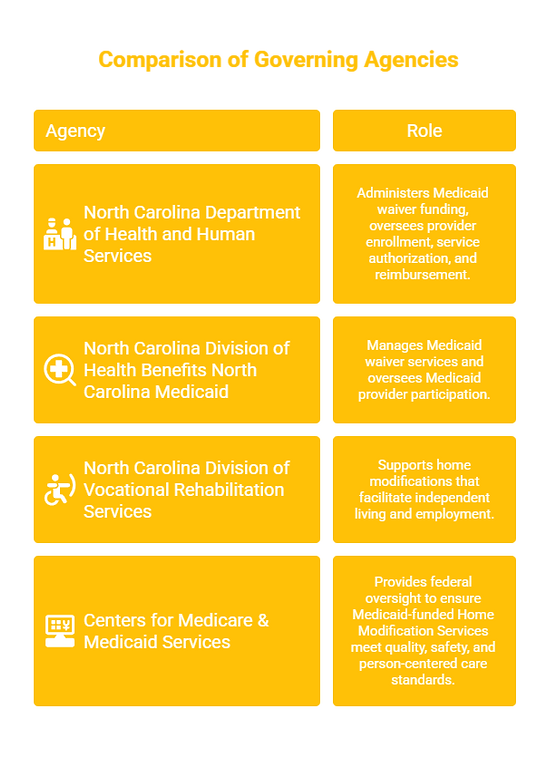
Community Transition
COMMUNITY TRANSITION SERVICES PROVIDER IN NORTH CAROLINA
FACILITATING SMOOTH TRANSITIONS FROM INSTITUTIONAL CARE TO COMMUNITY-BASED LIVING
Community Transition Services in North Carolina assist individuals moving from institutional settings, such as nursing homes or long-term care facilities, to community-based living arrangements. These services provide essential support during the transition, including housing assistance, personal care setup, and community integration. Community Transition Services are authorized under North Carolina Medicaid Home and Community-Based Services (HCBS) Waiver programs.
1. GOVERNING AGENCIES
Agency: North Carolina Department of Health and Human Services (NCDHHS)
Role: Administers Medicaid waiver funding for Community Transition Services and oversees provider enrollment, service authorization, and reimbursement.
Agency: North Carolina Division of Health Benefits (NC Medicaid)
Role: Manages Medicaid waiver services and oversees Medicaid provider participation.
Agency: North Carolina Division of Mental Health, Developmental Disabilities, and Substance Abuse Services (DMH/DD/SAS)
Role: Provides oversight for transition services targeting individuals with developmental disabilities and mental health needs.
Agency: Centers for Medicare & Medicaid Services (CMS)
Role: Provides federal oversight to ensure Medicaid-funded Community Transition Services meet quality, safety, and person-centered care standards.
2. COMMUNITY TRANSITION SERVICES OVERVIEW
Community Transition Services are designed to support individuals as they move from institutional care to community living, promoting independence and enhancing quality of life.
Approved providers may deliver:
Housing Assistance: Securing affordable, accessible housing options.
Household Setup: Purchasing essential items like furniture, bedding, and kitchenware.
Utility Connection: Assisting with setting up utilities such as electricity, water, and internet.
Personal Care Support: Arranging for in-home care services as needed.
Skill Building: Teaching independent living skills, such as budgeting and home maintenance.
Service Coordination: Connecting individuals to local resources, healthcare providers, and community programs.
Transportation Planning: Assisting with setting up reliable community or personal transportation.
Financial Planning: Helping manage budgeting, rent payments, and utility expenses.
Documentation: Maintaining records of transition plans, support services, and outcomes.
3. LICENSING & PROVIDER APPROVAL REQUIREMENTS
Prerequisites:
Register the business entity with the North Carolina Secretary of State.
Obtain EIN from the IRS and NPI (Type 2).
Enroll as a Medicaid Waiver Community Transition provider via the NCTracks Provider Portal.
Maintain general liability and professional liability insurance.
Develop policies for transition planning, community integration, and safety management.
Ensure staff complete required background checks, health screenings, and training in transition support practices.
4. NORTH CAROLINA PROVIDER ENROLLMENT PROCESS
Initial Interest and Application:
Complete the Provider Enrollment Application via the NCTracks Portal for Community Transition Services under HCBS waivers.
Application and Documentation Submission:
Submit Articles of Incorporation, proof of EIN/NPI, insurance certificates, transition policies, and staff training documentation.
Program Readiness Review:
NCDHHS and DMH/DD/SAS evaluate provider readiness, including transition protocols, safety measures, and staff qualifications.
Approval & Medicaid Enrollment:
Upon approval, providers are authorized to bill Medicaid for Community Transition Services using designated billing codes.
5. REQUIRED DOCUMENTATION
Articles of Incorporation or Business License (North Carolina Secretary of State)
IRS EIN confirmation
NPI confirmation
Proof of general and professional liability insurance
Community Transition Policy & Procedure Manual including:
Transition planning and independent living support procedures
Safety and emergency preparedness guidelines
Staff credentialing, background checks, and ongoing training records
Documentation standards for transition tracking and Medicaid billing
HIPAA compliance, participant rights, and grievance handling
Financial management support for transition expenses
Quality assurance and compliance monitoring
6. STAFFING REQUIREMENTS
Role: Community Transition Program Director
Requirements: Bachelor’s or Master’s degree in social work, human services, or healthcare administration; experience in transitional care and community integration.
Role: Transition Coordinators
Requirements: Experience in care coordination, housing assistance, and community support; background clearance.
Role: Independent Living Specialists
Requirements: Experience in skills training, personal care support, and client advocacy.
All staff must complete:
Training in transition planning, independent living support, and client interaction
HIPAA compliance and participant rights education
Annual competency evaluations and ongoing professional development
Safety, emergency response, and housing assistance training
Documentation and record-keeping best practices
7. MEDICAID WAIVER PROGRAMS
Community Transition Services are available under the following North Carolina Medicaid Waivers:
Innovations Waiver
Community Alternatives Program for Disabled Adults (CAP/DA)
Community Alternatives Program for Children (CAP/C)
Traumatic Brain Injury (TBI) Waiver
Home and Community-Based Services (HCBS) Waiver
8. TIMELINE TO LAUNCH
Phase: Business Formation and Compliance Preparation
Timeline: 1–2 months
Phase: Staff Hiring, Credentialing, and Program Development
Timeline: 2–3 months
Phase: North Carolina Medicaid Provider Enrollment and Readiness Review
Timeline: 60–90 days
Phase: Medicaid Billing Setup and Service Launch
Timeline: 30–45 days
9. CONTACT INFORMATION
North Carolina Department of Health and Human Services (NCDHHS)
Website: https://www.ncdhhs.gov/
NCTracks Provider Enrollment Portal
Website: https://www.nctracks.nc.gov/
North Carolina Division of Health Benefits (NC Medicaid)
Website: https://medicaid.ncdhhs.gov/
North Carolina Division of Mental Health, Developmental Disabilities, and Substance Abuse Services (DMH/DD/SAS)
Website: https://www.ncdhhs.gov/divisions/mhddsas
Centers for Medicare & Medicaid Services (CMS)
Website: https://www.cms.gov/
WAIVER CONSULTING GROUP’S START-UP ASSISTANCE SERVICE — NORTH CAROLINA COMMUNITY TRANSITION SERVICES PROVIDER
WCG supports agencies in launching Medicaid-compliant Community Transition Services in North Carolina, offering:
Scope of Work:
Business registration, Medicaid enrollment, and licensing assistance
Policy manual development for transition planning and independent living support
Staff credentialing, training program templates, and compliance documentation
Medicaid billing setup and audit-prepared financial management
Branding, website development, and client outreach strategies
Quality assurance systems for transition support and compliance monitoring
Collaboration with housing providers, healthcare agencies, and community organizations

Community Living & Supports
COMMUNITY LIVING AND SUPPORT SERVICES PROVIDER IN NORTH CAROLINA
PROMOTING INDEPENDENT LIVING AND SOCIAL INCLUSION THROUGH PERSONALIZED SUPPORT
Community Living and Support Services in North Carolina assist individuals with disabilities or chronic conditions in maintaining independence within their community. These services offer assistance with daily living activities, skill development, and community integration to enhance quality of life. Community Living and Support Services are authorized under North Carolina Medicaid Home and Community-Based Services (HCBS) Waiver programs.
1. GOVERNING AGENCIES
Agency: North Carolina Department of Health and Human Services (NCDHHS)
Role: Administers Medicaid waiver funding for Community Living and Support Services and oversees provider enrollment, service authorization, and reimbursement.
Agency: North Carolina Division of Health Benefits (NC Medicaid)
Role: Manages Medicaid waiver services and oversees Medicaid provider participation.
Agency: North Carolina Division of Mental Health, Developmental Disabilities, and Substance Abuse Services (DMH/DD/SAS)
Role: Provides oversight for community living services targeting individuals with developmental disabilities and behavioral health needs.
Agency: Centers for Medicare & Medicaid Services (CMS)
Role: Provides federal oversight to ensure Medicaid-funded Community Living and Support Services meet quality, safety, and person-centered care standards.
2. COMMUNITY LIVING AND SUPPORT SERVICES OVERVIEW
Community Living and Support Services help individuals live independently by offering assistance with daily tasks, fostering social skills, and supporting community involvement.
Approved providers may deliver:
Personal Care Assistance: Helping with grooming, dressing, hygiene, and meal preparation.
Community Integration: Facilitating participation in social, recreational, and community activities.
Life Skills Training: Teaching skills like budgeting, communication, and personal care.
Health and Safety Monitoring: Supporting safe living environments and daily wellness.
Companionship: Reducing social isolation through supportive interactions.
Transportation Assistance: Helping individuals access community resources and appointments.
Self-Advocacy Support: Empowering individuals to make decisions about their care.
Behavioral Support: Assisting with emotional regulation and positive behavioral practices.
Documentation: Maintaining records of support plans, progress, and community involvement.
3. LICENSING & PROVIDER APPROVAL REQUIREMENTS
Prerequisites:
Register the business entity with the North Carolina Secretary of State.
Obtain EIN from the IRS and NPI (Type 2).
Enroll as a Medicaid Waiver Community Living and Support provider via the NCTracks Provider Portal.
Maintain general liability and professional liability insurance.
Develop policies for independent living, community integration, and client safety.
Ensure staff complete required background checks, health screenings, and training in community support.
4. NORTH CAROLINA PROVIDER ENROLLMENT PROCESS
Initial Interest and Application:
Complete the Provider Enrollment Application via the NCTracks Portal for Community Living and Support Services under HCBS waivers.
Application and Documentation Submission:
Submit Articles of Incorporation, proof of EIN/NPI, insurance certificates, community support policies, and staff training documentation.
Program Readiness Review:
NCDHHS and DMH/DD/SAS evaluate provider readiness, including support protocols, safety standards, and staff qualifications.
Approval & Medicaid Enrollment:
Upon approval, providers are authorized to bill Medicaid for Community Living and Support Services using designated billing codes.
5. REQUIRED DOCUMENTATION
Articles of Incorporation or Business License (North Carolina Secretary of State)
IRS EIN confirmation
NPI confirmation
Proof of general and professional liability insurance
Community Living and Support Policy & Procedure Manual including:
Daily living assistance and community integration procedures
Behavioral support and self-advocacy training guidelines
Staff credentialing, background checks, and ongoing training records
Documentation standards for service tracking and Medicaid billing
HIPAA compliance, participant rights, and grievance handling
Safety and emergency response protocols
Quality assurance and compliance monitoring
6. STAFFING REQUIREMENTS
Role: Community Living Program Director
Requirements: Bachelor’s or Master’s degree in social work, human services, or healthcare administration; experience in community support program management.
Role: Community Support Specialists
Requirements: High school diploma or GED; experience in direct care, community support, or habilitation; background clearance.
Role: Personal Care Aides (PCAs)
Requirements: Completion of an approved PCA training program; experience in personal care and community engagement; background clearance.
All staff must complete:
Training in independent living, personal care, and client interaction
HIPAA compliance and participant rights education
Annual competency evaluations and ongoing professional development
Safety, emergency response, and behavioral support training
Documentation and record-keeping best practices
7. MEDICAID WAIVER PROGRAMS
Community Living and Support Services are available under the following North Carolina Medicaid Waivers:
Innovations Waiver
Community Alternatives Program for Disabled Adults (CAP/DA)
Community Alternatives Program for Children (CAP/C)
Traumatic Brain Injury (TBI) Waiver
Home and Community-Based Services (HCBS) Waiver
8. TIMELINE TO LAUNCH
Phase: Business Formation and Compliance Preparation
Timeline: 1–2 months
Phase: Staff Hiring, Credentialing, and Program Development
Timeline: 2–3 months
Phase: North Carolina Medicaid Provider Enrollment and Readiness Review
Timeline: 60–90 days
Phase: Medicaid Billing Setup and Service Launch
Timeline: 30–45 days
9. CONTACT INFORMATION
North Carolina Department of Health and Human Services (NCDHHS)
Website: https://www.ncdhhs.gov/
NCTracks Provider Enrollment Portal
Website: https://www.nctracks.nc.gov/
North Carolina Division of Health Benefits (NC Medicaid)
Website: https://medicaid.ncdhhs.gov/
North Carolina Division of Mental Health, Developmental Disabilities, and Substance Abuse Services (DMH/DD/SAS)
Website: https://www.ncdhhs.gov/divisions/mhddsas
Centers for Medicare & Medicaid Services (CMS)
Website: https://www.cms.gov/
WAIVER CONSULTING GROUP’S START-UP ASSISTANCE SERVICE — NORTH CAROLINA COMMUNITY LIVING AND SUPPORT SERVICES PROVIDER
WCG supports agencies in launching Medicaid-compliant Community Living and Support Services in North Carolina, offering:
Scope of Work:
Business registration, Medicaid enrollment, and licensing assistance
Policy manual development for community integration and client support
Staff credentialing, training program templates, and compliance documentation
Medicaid billing setup and audit-prepared financial management
Branding, website development, and community outreach strategies
Quality assurance systems for community support and compliance monitoring
Collaboration with healthcare providers and community organizations

Day Supports Services
DAY SUPPORT SERVICES PROVIDER IN NORTH CAROLINA
ENRICHING DAILY LIVES THROUGH SKILL DEVELOPMENT, COMMUNITY ENGAGEMENT, AND STRUCTURED ACTIVITIES
Day Support Services in North Carolina assist individuals with disabilities or chronic conditions by offering structured day programs that promote socialization, skill building, and community involvement. These services are designed to enhance independence, personal development, and quality of life. Day Support Services are authorized under North Carolina Medicaid Home and Community-Based Services (HCBS) Waiver programs.
1. GOVERNING AGENCIES
Agency: North Carolina Department of Health and Human Services (NCDHHS)
Role: Administers Medicaid waiver funding for Day Support Services and oversees provider enrollment, service authorization, and reimbursement.
Agency: North Carolina Division of Health Benefits (NC Medicaid)
Role: Manages Medicaid waiver services and oversees Medicaid provider participation.
Agency: North Carolina Division of Mental Health, Developmental Disabilities, and Substance Abuse Services (DMH/DD/SAS)
Role: Provides oversight for day support services targeting individuals with developmental disabilities and behavioral health needs.
Agency: Centers for Medicare & Medicaid Services (CMS)
Role: Provides federal oversight to ensure Medicaid-funded Day Support Services meet quality, safety, and person-centered care standards.
2. DAY SUPPORT SERVICES OVERVIEW
Day Support Services offer structured daytime programs to help individuals build social, vocational, and independent living skills while engaging in community-based activities.
Approved providers may deliver:
Skill Development Activities: Focusing on communication, social skills, and problem-solving.
Community Participation: Organizing group outings and community service projects.
Personal Development Programs: Enhancing self-care, self-advocacy, and personal responsibility.
Therapeutic Recreational Activities: Including arts, crafts, music, and physical activities.
Job Readiness Training: Preparing for volunteer opportunities or supported employment.
Health and Wellness Activities: Encouraging physical fitness and healthy lifestyle choices.
Social Interaction Opportunities: Fostering friendships and peer support networks.
Behavioral Support: Addressing challenging behaviors with positive reinforcement.
Supervision and Safety Monitoring: Ensuring participants' well-being throughout the program.
Documentation: Maintaining records of daily activities, progress tracking, and individual plans.
3. LICENSING & PROVIDER APPROVAL REQUIREMENTS
Prerequisites:
Register the business entity with the North Carolina Secretary of State.
Obtain EIN from the IRS and NPI (Type 2).
Enroll as a Medicaid Waiver Day Support provider via the NCTracks Provider Portal.
Maintain general liability and professional liability insurance.
Develop policies for program planning, client safety, and activity coordination.
Ensure staff complete required background checks, health screenings, and training in day support practices.
4. NORTH CAROLINA PROVIDER ENROLLMENT PROCESS
Initial Interest and Application:
Complete the Provider Enrollment Application via the NCTracks Portal for Day Support Services under HCBS waivers.
Application and Documentation Submission:
Submit Articles of Incorporation, proof of EIN/NPI, insurance certificates, day support policies, and staff training documentation.
Program Readiness Review:
NCDHHS and DMH/DD/SAS evaluate provider readiness, including program protocols, safety measures, and staff qualifications.
Approval & Medicaid Enrollment:
Upon approval, providers are authorized to bill Medicaid for Day Support Services using designated billing codes.
5. REQUIRED DOCUMENTATION
Articles of Incorporation or Business License (North Carolina Secretary of State)
IRS EIN confirmation
NPI confirmation
Proof of general and professional liability insurance
Day Support Policy & Procedure Manual including:
Activity planning and daily programming guidelines
Personal care, behavioral support, and safety protocols
Staff credentialing, background checks, and ongoing training records
Documentation standards for service tracking and Medicaid billing
HIPAA compliance, participant rights, and grievance handling
Safety, hygiene, and emergency response procedures
Quality assurance and compliance monitoring
6. STAFFING REQUIREMENTS
Role: Day Program Director
Requirements: Bachelor’s or Master’s degree in social work, human services, or healthcare administration; experience in program management and community engagement.
Role: Day Support Specialists
Requirements: High school diploma or GED; experience in direct care or habilitation support; background clearance.
Role: Activity Coordinators
Requirements: Experience in recreational therapy, community programming, or group facilitation.
All staff must complete:
Training in activity planning, safety protocols, and client interaction
HIPAA compliance and participant rights education
Annual competency evaluations and ongoing professional development
Safety, crisis management, and behavior support training
Documentation and record-keeping best practices
7. MEDICAID WAIVER PROGRAMS
Day Support Services are available under the following North Carolina Medicaid Waivers:
Innovations Waiver
Community Alternatives Program for Disabled Adults (CAP/DA)
Community Alternatives Program for Children (CAP/C)
Traumatic Brain Injury (TBI) Waiver
Home and Community-Based Services (HCBS) Waiver
8. TIMELINE TO LAUNCH
Phase: Business Formation and Compliance Preparation
Timeline: 1–2 months
Phase: Staff Hiring, Credentialing, and Program Development
Timeline: 2–3 months
Phase: North Carolina Medicaid Provider Enrollment and Readiness Review
Timeline: 60–90 days
Phase: Medicaid Billing Setup and Day Support Service Launch
Timeline: 30–45 days
9. CONTACT INFORMATION
North Carolina Department of Health and Human Services (NCDHHS)
Website: https://www.ncdhhs.gov/
NCTracks Provider Enrollment Portal
Website: https://www.nctracks.nc.gov/
North Carolina Division of Health Benefits (NC Medicaid)
Website: https://medicaid.ncdhhs.gov/
North Carolina Division of Mental Health, Developmental Disabilities, and Substance Abuse Services (DMH/DD/SAS)
Website: https://www.ncdhhs.gov/divisions/mhddsas
Centers for Medicare & Medicaid Services (CMS)
Website: https://www.cms.gov/
WAIVER CONSULTING GROUP’S START-UP ASSISTANCE SERVICE — NORTH CAROLINA DAY SUPPORT SERVICES PROVIDER
WCG supports agencies in launching Medicaid-compliant Day Support Services in North Carolina, offering:
Scope of Work:
Business registration, Medicaid enrollment, and licensing assistance
Policy manual development for day programming and community engagement
Staff credentialing, training program templates, and compliance documentation
Medicaid billing setup and audit-prepared financial management
Branding, website development, and client outreach strategies
Quality assurance systems for program safety and compliance monitoring
Collaboration with healthcare providers, community organizations, and activity specialists

Crisis Intervention
CRISIS INTERVENTION SERVICES PROVIDER IN NORTH CAROLINA
PROVIDING IMMEDIATE AND EFFECTIVE SUPPORT DURING MENTAL HEALTH OR BEHAVIORAL CRISES
Crisis Intervention Services in North Carolina assist individuals experiencing mental health or behavioral crises by offering immediate, short-term support to stabilize the situation and ensure safety. These services are critical for preventing escalation, addressing acute needs, and linking individuals to ongoing support. Crisis Intervention Services are authorized under North Carolina Medicaid Home and Community-Based Services (HCBS) Waiver programs.
1. GOVERNING AGENCIES
Agency: North Carolina Department of Health and Human Services (NCDHHS)
Role: Administers Medicaid waiver funding for Crisis Intervention Services and oversees provider enrollment, service authorization, and reimbursement.
Agency: North Carolina Division of Health Benefits (NC Medicaid)
Role: Manages Medicaid waiver services and oversees Medicaid provider participation.
Agency: North Carolina Division of Mental Health, Developmental Disabilities, and Substance Abuse Services (DMH/DD/SAS)
Role: Provides oversight for crisis intervention services targeting individuals with mental health or developmental disabilities.
Agency: Centers for Medicare & Medicaid Services (CMS)
Role: Provides federal oversight to ensure Medicaid-funded Crisis Intervention Services meet quality, safety, and person-centered care standards.
2. CRISIS INTERVENTION SERVICES OVERVIEW
Crisis Intervention Services aim to de-escalate situations involving mental health emergencies, behavioral disruptions, or acute stress, offering support to individuals and their families.
Approved providers may deliver:
Mobile Crisis Response: Providing on-site support during behavioral or mental health emergencies.
Crisis Assessment: Evaluating the immediate needs and risk factors involved in the crisis.
De-escalation Techniques: Utilizing calming strategies to reduce agitation or aggression.
Safety Planning: Developing short-term safety measures to stabilize the situation.
Supportive Counseling: Offering emotional support and coping strategies during the crisis.
Linkage to Ongoing Support: Connecting individuals with follow-up mental health services or community resources.
Crisis Stabilization: Temporary support in a safe environment to prevent hospitalization.
Family Support and Education: Guiding family members on managing crisis situations effectively.
24/7 Crisis Hotline: Providing immediate telephonic assistance and guidance.
Documentation: Maintaining accurate records of crisis incidents, interventions, and outcomes.
3. LICENSING & PROVIDER APPROVAL REQUIREMENTS
Prerequisites:
Register the business entity with the North Carolina Secretary of State.
Obtain EIN from the IRS and NPI (Type 2).
Enroll as a Medicaid Waiver Crisis Intervention provider via the NCTracks Provider Portal.
Maintain general liability and professional liability insurance.
Develop policies for crisis response, de-escalation techniques, and safety protocols.
Ensure staff complete required background checks, health screenings, and training in crisis intervention practices.
4. NORTH CAROLINA PROVIDER ENROLLMENT PROCESS
Initial Interest and Application:
Complete the Provider Enrollment Application via the NCTracks Portal for Crisis Intervention Services under HCBS waivers.
Application and Documentation Submission:
Submit Articles of Incorporation, proof of EIN/NPI, insurance certificates, crisis response policies, and staff training documentation.
Program Readiness Review:
NCDHHS and DMH/DD/SAS evaluate provider readiness, including response protocols, safety measures, and staff qualifications.
Approval & Medicaid Enrollment:
Upon approval, providers are authorized to bill Medicaid for Crisis Intervention Services using designated billing codes.
5. REQUIRED DOCUMENTATION
Articles of Incorporation or Business License (North Carolina Secretary of State)
IRS EIN confirmation
NPI confirmation
Proof of general and professional liability insurance
Crisis Intervention Policy & Procedure Manual including:
Crisis response, de-escalation, and safety planning protocols
Mobile crisis response and hotline management procedures
Staff credentialing, background checks, and ongoing training records
Documentation standards for crisis tracking and Medicaid billing
HIPAA compliance, participant rights, and grievance handling
Safety, incident reporting, and emergency response guidelines
Quality assurance and compliance monitoring
6. STAFFING REQUIREMENTS
Role: Crisis Program Director
Requirements: Master’s degree in social work, psychology, counseling, or a related field; state licensure (LCSW, LMHC, or LPC); experience in crisis management and supervision.
Role: Crisis Counselors
Requirements: Master’s degree in mental health counseling, social work, or psychology; state licensure or certification in crisis intervention; background clearance.
Role: Mobile Crisis Responders
Requirements: Training in mental health crisis response, de-escalation techniques, and community safety protocols.
Role: Hotline Operators
Requirements: Experience in mental health support, crisis management, and telephonic intervention.
All staff must complete:
Training in crisis intervention, de-escalation, and mental health first aid
HIPAA compliance and participant rights education
Annual competency evaluations and ongoing professional development
Safety, emergency response, and client interaction training
Documentation and record-keeping best practices
7. MEDICAID WAIVER PROGRAMS
Crisis Intervention Services are available under the following North Carolina Medicaid Waivers:
Innovations Waiver
Community Alternatives Program for Disabled Adults (CAP/DA)
Community Alternatives Program for Children (CAP/C)
Traumatic Brain Injury (TBI) Waiver
Home and Community-Based Services (HCBS) Waiver
8. TIMELINE TO LAUNCH
Phase: Business Formation and Compliance Preparation
Timeline: 1–2 months
Phase: Staff Hiring, Credentialing, and Program Development
Timeline: 2–3 months
Phase: North Carolina Medicaid Provider Enrollment and Readiness Review
Timeline: 60–90 days
Phase: Medicaid Billing Setup and Crisis Intervention Service Launch
Timeline: 30–45 days
9. CONTACT INFORMATION
North Carolina Department of Health and Human Services (NCDHHS)
Website: https://www.ncdhhs.gov/
NCTracks Provider Enrollment Portal
Website: https://www.nctracks.nc.gov/
North Carolina Division of Health Benefits (NC Medicaid)
Website: https://medicaid.ncdhhs.gov/
North Carolina Division of Mental Health, Developmental Disabilities, and Substance Abuse Services (DMH/DD/SAS)
Website: https://www.ncdhhs.gov/divisions/mhddsas
Centers for Medicare & Medicaid Services (CMS)
Website: https://www.cms.gov/
WAIVER CONSULTING GROUP’S START-UP ASSISTANCE SERVICE — NORTH CAROLINA CRISIS INTERVENTION SERVICES PROVIDER
WCG supports agencies in launching Medicaid-compliant Crisis Intervention Services in North Carolina, offering:
Scope of Work:
Business registration, Medicaid enrollment, and licensing assistance
Policy manual development for crisis management and safety compliance
Staff credentialing, training program templates, and compliance documentation
Medicaid billing setup and audit-prepared financial management
Branding, website development, and client outreach strategies
Quality assurance systems for crisis intervention and compliance monitoring
Collaboration with healthcare providers, mental health agencies, and community organizations

Adult Health Transportation
NON-MEDICAL TRANSPORTATION SERVICES PROVIDER IN NORTH CAROLINA
ENSURING ACCESS TO COMMUNITY ACTIVITIES AND ESSENTIAL SERVICES THROUGH SAFE AND RELIABLE TRANSPORTATION
Non-Medical Transportation Services in North Carolina help individuals with disabilities, chronic conditions, or age-related challenges access essential community services, employment, social activities, and other non-medical destinations. These services are crucial for maintaining independence and active community participation. Non-Medical Transportation Services are authorized under North Carolina Medicaid Home and Community-Based Services (HCBS) Waiver programs.
1. GOVERNING AGENCIES
Agency: North Carolina Department of Health and Human Services (NCDHHS)
Role: Administers Medicaid waiver funding for Non-Medical Transportation Services and oversees provider enrollment, service authorization, and reimbursement.
Agency: North Carolina Division of Health Benefits (NC Medicaid)
Role: Manages Medicaid waiver services and oversees Medicaid provider participation.
Agency: North Carolina Division of Mental Health, Developmental Disabilities, and Substance Abuse Services (DMH/DD/SAS)
Role: Provides oversight for transportation services targeting individuals with developmental disabilities and behavioral health needs.
Agency: Centers for Medicare & Medicaid Services (CMS)
Role: Provides federal oversight to ensure Medicaid-funded Non-Medical Transportation Services meet quality, safety, and person-centered care standards.
2. NON-MEDICAL TRANSPORTATION SERVICES OVERVIEW
Non-Medical Transportation Services provide safe and reliable transportation to help individuals access community activities, social events, employment opportunities, and essential non-medical services.
Approved providers may deliver:
Community Access Transportation: Rides to community events, social activities, and recreational programs.
Employment Transportation: Reliable transport to and from workplaces or vocational programs.
Educational Access: Transportation to educational and training programs.
Personal Errands: Assistance with transportation for shopping, banking, and other daily tasks.
Social and Recreational Support: Enabling participation in group outings and leisure activities.
Escort and Assistance: Providing support during transit, including mobility and boarding assistance.
Trip Planning and Scheduling: Coordinating transportation according to individual needs and schedules.
Safety Monitoring: Ensuring the safety and comfort of passengers during transit.
Documentation: Keeping accurate trip logs, mileage records, and service reports.
3. LICENSING & PROVIDER APPROVAL REQUIREMENTS
Prerequisites:
Register the business entity with the North Carolina Secretary of State.
Obtain EIN from the IRS and NPI (Type 2).
Enroll as a Medicaid Waiver Non-Medical Transportation provider via the NCTracks Provider Portal.
Maintain general liability, vehicle insurance, and professional liability insurance.
Develop policies for transportation safety, scheduling, and vehicle maintenance.
Ensure drivers complete required background checks, health screenings, and defensive driving training.
4. NORTH CAROLINA PROVIDER ENROLLMENT PROCESS
Initial Interest and Application:
Complete the Provider Enrollment Application via the NCTracks Portal for Non-Medical Transportation Services under HCBS waivers.
Application and Documentation Submission:
Submit Articles of Incorporation, proof of EIN/NPI, insurance certificates, transportation policies, and driver training documentation.
Program Readiness Review:
NCDHHS and DMH/DD/SAS evaluate provider readiness, including vehicle safety protocols, driver qualifications, and passenger assistance methods.
Approval & Medicaid Enrollment:
Upon approval, providers are authorized to bill Medicaid for Non-Medical Transportation Services using designated billing codes.
5. REQUIRED DOCUMENTATION
Articles of Incorporation or Business License (North Carolina Secretary of State)
IRS EIN confirmation
NPI confirmation
Proof of general, professional liability, and vehicle insurance
Non-Medical Transportation Policy & Procedure Manual including:
Trip planning and scheduling procedures
Safety protocols for passenger support and mobility assistance
Driver credentialing, background checks, and ongoing training records
Vehicle maintenance logs and safety inspection documentation
Documentation standards for trip tracking and Medicaid billing
HIPAA compliance, passenger rights, and grievance handling
Emergency response and accident reporting protocols
Quality assurance and compliance monitoring
6. STAFFING REQUIREMENTS
Role: Transportation Program Director
Requirements: Bachelor’s degree in business management, logistics, or a related field; experience in transportation coordination and compliance management.
Role: Drivers/Transportation Specialists
Requirements: Valid commercial driver’s license (CDL) with passenger endorsement; defensive driving certification; experience in transporting individuals with disabilities.
Role: Transportation Coordinators
Requirements: Experience in scheduling, logistics, and trip planning; background clearance.
All staff must complete:
Training in passenger safety, mobility support, and defensive driving
HIPAA compliance and passenger rights education
Annual competency evaluations and ongoing professional development
Safety, emergency response, and incident management training
Documentation and record-keeping best practices
7. MEDICAID WAIVER PROGRAMS
Non-Medical Transportation Services are available under the following North Carolina Medicaid Waivers:
Innovations Waiver
Community Alternatives Program for Disabled Adults (CAP/DA)
Community Alternatives Program for Children (CAP/C)
Traumatic Brain Injury (TBI) Waiver
Home and Community-Based Services (HCBS) Waiver
8. TIMELINE TO LAUNCH
Phase: Business Formation and Compliance Preparation
Timeline: 1–2 months
Phase: Staff Hiring, Credentialing, and Program Development
Timeline: 2–3 months
Phase: North Carolina Medicaid Provider Enrollment and Readiness Review
Timeline: 60–90 days
Phase: Medicaid Billing Setup and Service Launch
Timeline: 30–45 days
9. CONTACT INFORMATION
North Carolina Department of Health and Human Services (NCDHHS)
Website: https://www.ncdhhs.gov/
NCTracks Provider Enrollment Portal
Website: https://www.nctracks.nc.gov/
North Carolina Division of Health Benefits (NC Medicaid)
Website: https://medicaid.ncdhhs.gov/
North Carolina Division of Mental Health, Developmental Disabilities, and Substance Abuse Services (DMH/DD/SAS)
Website: https://www.ncdhhs.gov/divisions/mhddsas
Centers for Medicare & Medicaid Services (CMS)
Website: https://www.cms.gov/
WAIVER CONSULTING GROUP’S START-UP ASSISTANCE SERVICE — NORTH CAROLINA NON-MEDICAL TRANSPORTATION SERVICES PROVIDER
WCG supports agencies in launching Medicaid-compliant Non-Medical Transportation Services in North Carolina, offering:
Scope of Work:
Business registration, Medicaid enrollment, and licensing assistance
Policy manual development for transportation safety and trip planning
Staff credentialing, training program templates, and compliance documentation
Medicaid billing setup and audit-prepared financial management
Branding, website development, and community outreach strategies
Quality assurance systems for transportation safety and compliance monitoring
Collaboration with healthcare providers and community organizations

Home Health
HOME HEALTH CARE SERVICES PROVIDER IN NORTH CAROLINA
DELIVERING COMPREHENSIVE MEDICAL AND PERSONAL CARE IN THE COMFORT OF HOME
Home Health Care Services in North Carolina provide medical and personal care to individuals in their homes, allowing them to manage chronic conditions, recover from illness, or maintain independence. These services are essential for individuals who prefer to receive care at home rather than in a healthcare facility. Home Health Care Services are authorized under North Carolina Medicaid Home and Community-Based Services (HCBS) Waiver programs.
1. GOVERNING AGENCIES
Agency: North Carolina Department of Health and Human Services (NCDHHS)
Role: Administers Medicaid waiver funding for Home Health Care Services and oversees provider enrollment, service authorization, and reimbursement.
Agency: North Carolina Division of Health Benefits (NC Medicaid)
Role: Manages Medicaid waiver services and oversees Medicaid provider participation.
Agency: North Carolina Division of Health Service Regulation (DHSR)
Role: Regulates home health agency licensing and compliance with state regulations.
Agency: Centers for Medicare & Medicaid Services (CMS)
Role: Provides federal oversight to ensure Medicaid-funded Home Health Care Services meet quality, safety, and person-centered care standards.
2. HOME HEALTH CARE SERVICES OVERVIEW
Home Health Care Services involve a range of medical and non-medical care delivered directly in the individual's home. These services help maintain health, manage chronic conditions, and support recovery from illness or surgery.
Approved providers may deliver:
Skilled Nursing Care: Administering medication, wound care, and chronic disease management.
Physical Therapy: Improving mobility, strength, and coordination through rehabilitative exercises.
Occupational Therapy: Enhancing daily living skills and promoting independence.
Speech Therapy: Assisting with communication and swallowing disorders.
Home Health Aide Support: Personal care, hygiene assistance, and mobility support.
Medical Social Services: Providing counseling and resource coordination for healthcare access.
Medication Management: Ensuring proper administration and monitoring of medications.
Chronic Condition Monitoring: Tracking vital signs and managing health changes.
Post-Hospitalization Care: Supporting recovery at home after hospital discharge.
Documentation: Maintaining detailed care plans, progress notes, and patient assessments.
3. LICENSING & PROVIDER APPROVAL REQUIREMENTS
Prerequisites:
Register the business entity with the North Carolina Secretary of State.
Obtain EIN from the IRS and NPI (Type 2).
Enroll as a Medicaid Waiver Home Health Care provider via the NCTracks Provider Portal.
Obtain licensure as a Home Care Agency from the North Carolina Division of Health Service Regulation (DHSR).
Maintain general liability and professional liability insurance.
Develop policies for medical care, safety protocols, and patient support.
Ensure staff complete required background checks, health screenings, and professional licensure verifications.
4. NORTH CAROLINA PROVIDER ENROLLMENT PROCESS
Initial Interest and Application:
Complete the Provider Enrollment Application via the NCTracks Portal for Home Health Care Services under HCBS waivers.
Application and Documentation Submission:
Submit Articles of Incorporation, proof of EIN/NPI, insurance certificates, healthcare policies, and staff licensure documentation.
Program Readiness Review:
NCDHHS and DHSR evaluate provider readiness, including clinical protocols, safety measures, and staff qualifications.
Approval & Medicaid Enrollment:
Upon approval, providers are authorized to bill Medicaid for Home Health Care Services using designated billing codes.
5. REQUIRED DOCUMENTATION
Articles of Incorporation or Business License (North Carolina Secretary of State)
IRS EIN confirmation
NPI confirmation
Proof of general and professional liability insurance
Home Health Care Policy & Procedure Manual including:
Medical care protocols and medication management guidelines
Safety, infection control, and hygiene standards
Staff credentialing, background checks, and ongoing training records
Documentation standards for care tracking and Medicaid billing
HIPAA compliance, patient rights, and grievance handling
Emergency response and patient safety protocols
Quality assurance and compliance monitoring
6. STAFFING REQUIREMENTS
Role: Home Health Program Director
Requirements: Registered Nurse (RN) license, Bachelor’s or Master’s in Nursing or Healthcare Administration; experience in clinical supervision and home health care.
Role: Registered Nurses (RNs)
Requirements: Active RN license; experience in home health care; CPR and BLS certifications.
Role: Licensed Practical Nurses (LPNs)
Requirements: State licensure; experience in patient care and medication administration.
Role: Home Health Aides (HHAs)
Requirements: Certified HHA training program completion; experience in personal care assistance.
Role: Physical/Occupational/Speech Therapists
Requirements: Appropriate licensure and certification in therapy specialties.
All staff must complete:
Training in patient care, chronic disease management, and safety protocols
HIPAA compliance and patient rights education
Annual competency evaluations and ongoing professional development
Safety, infection control, and emergency response training
Documentation and record-keeping best practices
7. MEDICAID WAIVER PROGRAMS
Home Health Care Services are available under the following North Carolina Medicaid Waivers:
Innovations Waiver
Community Alternatives Program for Disabled Adults (CAP/DA)
Community Alternatives Program for Children (CAP/C)
Traumatic Brain Injury (TBI) Waiver
Home and Community-Based Services (HCBS) Waiver
8. TIMELINE TO LAUNCH
Phase: Business Formation and Compliance Preparation
Timeline: 1–2 months
Phase: Staff Hiring, Credentialing, and Program Development
Timeline: 2–3 months
Phase: North Carolina Medicaid Provider Enrollment and Readiness Review
Timeline: 60–90 days
Phase: Medicaid Billing Setup and Home Health Service Launch
Timeline: 30–45 days
9. CONTACT INFORMATION
North Carolina Department of Health and Human Services (NCDHHS)
Website: https://www.ncdhhs.gov/
NCTracks Provider Enrollment Portal
Website: https://www.nctracks.nc.gov/
North Carolina Division of Health Service Regulation (DHSR)
Website: https://info.ncdhhs.gov/dhsr/
North Carolina Division of Health Benefits (NC Medicaid)
Website: https://medicaid.ncdhhs.gov/
Centers for Medicare & Medicaid Services (CMS)
Website: https://www.cms.gov/
WAIVER CONSULTING GROUP’S START-UP ASSISTANCE SERVICE — NORTH CAROLINA HOME HEALTH CARE SERVICES PROVIDER
WCG supports agencies in launching Medicaid-compliant Home Health Care Services in North Carolina, offering:
Scope of Work:
Business registration, Medicaid enrollment, and licensing assistance
Policy manual development for clinical care and patient safety
Staff credentialing, training program templates, and compliance documentation
Medicaid billing setup and audit-prepared financial management
Branding, website development, and community outreach strategies
Quality assurance systems for home health care and compliance monitoring
Collaboration with healthcare providers and community organizations

Meal & Nutrition
MEAL AND NUTRITION SERVICES PROVIDER IN NORTH CAROLINA
PROMOTING HEALTH AND WELL-BEING THROUGH PERSONALIZED MEAL PLANNING AND NUTRITION SUPPORT
Meal and Nutrition Services in North Carolina assist individuals with disabilities, chronic conditions, or age-related challenges by providing access to nutritious meals, dietary planning, and nutritional education. These services support health maintenance, chronic condition management, and enhanced quality of life. Meal and Nutrition Services are authorized under North Carolina Medicaid Home and Community-Based Services (HCBS) Waiver programs.
1. GOVERNING AGENCIES
Agency: North Carolina Department of Health and Human Services (NCDHHS)
Role: Administers Medicaid waiver funding for Meal and Nutrition Services and oversees provider enrollment, service authorization, and reimbursement.
Agency: North Carolina Division of Health Benefits (NC Medicaid)
Role: Manages Medicaid waiver services and oversees Medicaid provider participation.
Agency: North Carolina Division of Mental Health, Developmental Disabilities, and Substance Abuse Services (DMH/DD/SAS)
Role: Provides oversight for meal and nutrition services targeting individuals with developmental disabilities and behavioral health needs.
Agency: Centers for Medicare & Medicaid Services (CMS)
Role: Provides federal oversight to ensure Medicaid-funded Meal and Nutrition Services meet quality, safety, and person-centered care standards.
2. MEAL AND NUTRITION SERVICES OVERVIEW
Meal and Nutrition Services provide individuals with assistance in meal preparation, dietary planning, and nutritional education to maintain health and manage specific dietary needs.
Approved providers may deliver:
Meal Preparation: Cooking and preparing balanced meals that align with dietary restrictions.
Meal Delivery: Providing pre-cooked, nutritionally balanced meals to homes.
Dietary Assessment: Evaluating nutritional needs based on medical conditions or dietary goals.
Nutritional Counseling: Offering guidance on healthy eating and meal planning.
Special Diet Management: Preparing meals tailored for diabetes, hypertension, or other chronic conditions.
Food Safety Education: Teaching safe food handling and storage practices.
Shopping Assistance: Helping individuals purchase groceries and plan healthy meals.
Culinary Skill Training: Teaching basic cooking skills for increased independence.
Community Meal Programs: Organizing group dining events to enhance social interaction.
Documentation: Maintaining records of meal plans, dietary assessments, and nutritional education.
3. LICENSING & PROVIDER APPROVAL REQUIREMENTS
Prerequisites:
Register the business entity with the North Carolina Secretary of State.
Obtain EIN from the IRS and NPI (Type 2).
Enroll as a Medicaid Waiver Meal and Nutrition provider via the NCTracks Provider Portal.
Maintain general liability and professional liability insurance.
Develop policies for meal planning, dietary safety, and client nutrition education.
Ensure staff complete required background checks, health screenings, and nutrition training.
4. NORTH CAROLINA PROVIDER ENROLLMENT PROCESS
Initial Interest and Application:
Complete the Provider Enrollment Application via the NCTracks Portal for Meal and Nutrition Services under HCBS waivers.
Application and Documentation Submission:
Submit Articles of Incorporation, proof of EIN/NPI, insurance certificates, nutrition policies, and staff training documentation.
Program Readiness Review:
NCDHHS and DMH/DD/SAS evaluate provider readiness, including meal safety protocols, dietary planning standards, and staff qualifications.
Approval & Medicaid Enrollment:
Upon approval, providers are authorized to bill Medicaid for Meal and Nutrition Services using designated billing codes.
5. REQUIRED DOCUMENTATION
Articles of Incorporation or Business License (North Carolina Secretary of State)
IRS EIN confirmation
NPI confirmation
Proof of general and professional liability insurance
Meal and Nutrition Policy & Procedure Manual including:
Meal planning, preparation, and delivery protocols
Nutritional assessment and dietary planning guidelines
Staff credentialing, background checks, and ongoing training records
Documentation standards for meal tracking and Medicaid billing
HIPAA compliance, participant rights, and grievance handling
Safety, hygiene, and food handling protocols
Quality assurance and compliance monitoring
6. STAFFING REQUIREMENTS
Role: Nutrition Program Director
Requirements: Registered Dietitian (RD) license, Bachelor’s or Master’s in Nutrition or Dietetics; experience in meal planning and program management.
Role: Dietitians/Nutritionists
Requirements: State licensure and certification in dietetics or nutrition; experience in dietary planning and meal preparation.
Role: Meal Preparation Staff
Requirements: Experience in food service, meal preparation, and dietary compliance; food handler certification preferred.
Role: Delivery Drivers
Requirements: Valid driver’s license; experience in food delivery and customer service; background clearance.
All staff must complete:
Training in food safety, nutrition planning, and dietary management
HIPAA compliance and participant rights education
Annual competency evaluations and ongoing professional development
Safety, hygiene, and emergency response training
Documentation and record-keeping best practices
7. MEDICAID WAIVER PROGRAMS
Meal and Nutrition Services are available under the following North Carolina Medicaid Waivers:
Innovations Waiver
Community Alternatives Program for Disabled Adults (CAP/DA)
Community Alternatives Program for Children (CAP/C)
Traumatic Brain Injury (TBI) Waiver
Home and Community-Based Services (HCBS) Waiver
8. TIMELINE TO LAUNCH
Phase: Business Formation and Compliance Preparation
Timeline: 1–2 months
Phase: Staff Hiring, Credentialing, and Program Development
Timeline: 2–3 months
Phase: North Carolina Medicaid Provider Enrollment and Readiness Review
Timeline: 60–90 days
Phase: Medicaid Billing Setup and Service Launch
Timeline: 30–45 days
9. CONTACT INFORMATION
North Carolina Department of Health and Human Services (NCDHHS)
Website: https://www.ncdhhs.gov/
NCTracks Provider Enrollment Portal
Website: https://www.nctracks.nc.gov/
North Carolina Division of Health Benefits (NC Medicaid)
Website: https://medicaid.ncdhhs.gov/
North Carolina Division of Mental Health, Developmental Disabilities, and Substance Abuse Services (DMH/DD/SAS)
Website: https://www.ncdhhs.gov/divisions/mhddsas
Centers for Medicare & Medicaid Services (CMS)
Website: https://www.cms.gov/
WAIVER CONSULTING GROUP’S START-UP ASSISTANCE SERVICE — NORTH CAROLINA MEAL AND NUTRITION SERVICES PROVIDER
WCG supports agencies in launching Medicaid-compliant Meal and Nutrition Services in North Carolina, offering:
Scope of Work:
Business registration, Medicaid enrollment, and licensing assistance
Policy manual development for dietary planning and meal safety
Staff credentialing, training program templates, and compliance documentation
Medicaid billing setup and audit-prepared financial management
Branding, website development, and client outreach strategies
Quality assurance systems for meal service and compliance monitoring
Collaboration with dietitians, healthcare providers, and community organizations

Our Client Portal offers a wealth of resources that you can explore related to various programs and state requirements.